World War Z
The zombie war is over, and a UN investigator is collecting what the survivors remember
Chapter IAbout the book
- First published
- 2006
- Main genre
- Science fiction
- Length
- 342 pages
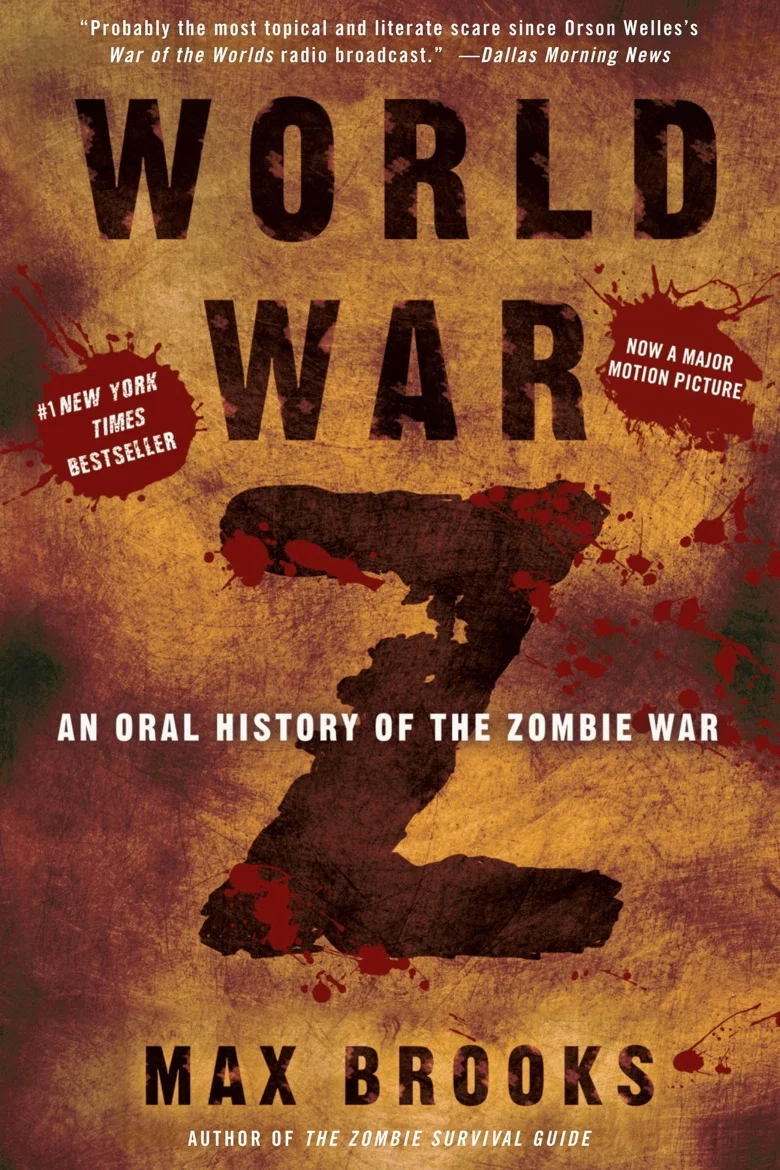
After the zombie war has ended, an agent of a United Nations commission travels the world to record what the survivors remember. World War Z is told entirely in interviews, and its author says it has no hero, because nobody is saving the world. It is a collection of individual accounts told to and recorded by an agent of the United Nations Postwar Commission, and it has eight chapters that move through the course of the war. The speakers are soldiers, doctors, engineers, refugees and politicians from many countries, and the book covers the social, political, religious, economic and environmental changes that followed. Brooks asked what had happened to the rest of the world, to Russia, China and Africa, rather than telling the story of one group in one place. Because every account is a memory, the reader knows who lived and who died, which removes suspense and puts the weight on how people behaved. It is a follow-up to Brooks's The Zombie Survival Guide, published in 2003, but its tone is far more serious, and the zombies are less a monster than a way of testing governments, markets and nerves under pressure.
Chapter IIThe author and the making
Max Brooks first wrote The Zombie Survival Guide in 1998 and 1999, and it was published in 2003. Its first printing was 17,000 copies, and it went on to sell a million. For his next book he wanted something broader. He said he did not want another zombie adventure story and asked what the rest of the world, Russia, China and Africa, would have looked like. The template he chose was Studs Terkel's 1984 oral history of World War II, The Good War, which he read as a teenager. He has said that without Terkel's The Good War there would be no World War Z. The format came easily; the hard part was research. He said he had to do just as many real interviews with real people who do those real jobs, and he named Tom Clancy as a model for doing the homework that makes the real world interesting. He wanted everything to be real, and he described the result as almost more a work of journalism than of fiction. Crown published it on September 12, 2006, as a 342-page book. The rights drew a bidding war in 2006. Brooks kept China in the story and refused to censor it, which is why the book is not published in China.
Chapter IIIHow it was received
World War Z was a commercial hit and was praised by most critics. The full-cast audiobook of 2007, with Alan Alda, Mark Hamill and John Turturro, won an Audie Award. Readers took it as more than horror: Brooks used the book to comment on government ineptitude and U.S. isolationism. The film, released in 2013 and directed by Marc Forster with Brad Pitt, was only loosely based on the novel. Brooks kept his distance: “I'm just the guy that wrote the book.” He observed that many people preferred the movie because it has a hero and action scenes, while his own book is all talky and thinky, and that he did not mind its changes, such as moving Patient Zero to South Korea, as long as nobody altered his book. The book's own limits were acknowledged by Brooks: because the speakers are survivors, readers can tell who lived and who died, and there is no hero. He also said he would not write a sequel just for money, and did not want to produce World War Z, Part 2: The Search For More Money.
Chapter IVWhy it matters
World War Z matters as the book that took the zombie out of the horror aisle and used it as a tool for political and social fiction. By borrowing the oral history form from Studs Terkel, Brooks made a planetary catastrophe into a mosaic of ordinary voices, and many of its scenes of logistics, refugees and food supply linger longer than any monster. Its political reading, on government ineptitude and isolationism, has kept it in conversation as new crises arrive. It is also an example of how research can carry fiction: Brooks did real interviews with people who do the real jobs he describes. Know what you are getting. There is no hero and no through-line plot, so the book rewards readers who like voices and ideas more than a single chase, and fans of the film will find a very different, quieter work. The accounts vary in length and tone, and some readers find the form episodic. It suits readers who enjoy collages of testimony and a what-if told straight, and it is a poor fit for those who want a continuous action story. Brooks's own warning, that the book is talky and thinky, is fair.
Chapter VIf you liked this
- The Good War Studs TerkelThe 1984 oral history of the Second World War that Brooks used as his template
- The Zombie Survival Guide Max BrooksBrooks's earlier, lighter handbook, the book World War Z follows up
- The Road Cormac McCarthyA bleaker, quieter look at survival after collapse
- Station Eleven Emily St. John MandelA post-pandemic novel built from several lives across time
- Science fiction
- Horror
- Political fiction
Buying links are coming soon.