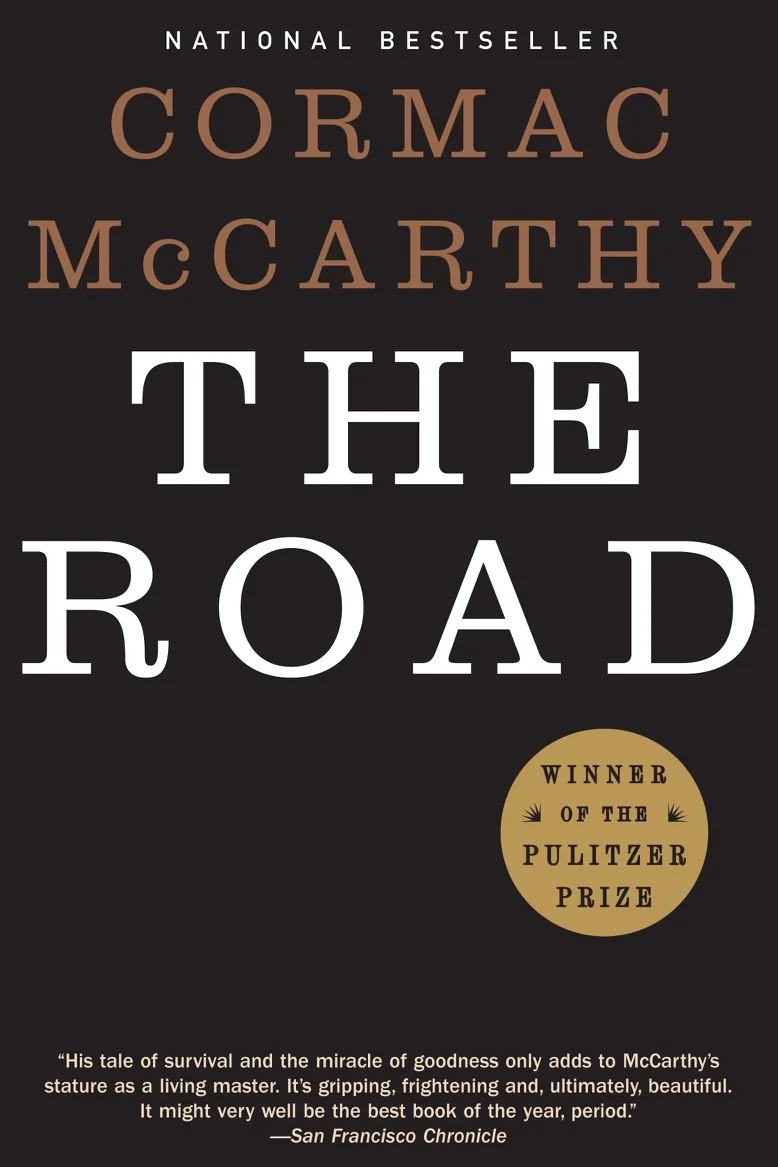
The Road
A father and his son walk south through the ashes, with nothing but each other and a promise to stay good
Chapter IAbout the book
- First published
- 2006
- Main genre
- Literary fiction
- Length
- 287 pages
A father and his young son walk south across an ash-covered America, towards the sea, to get ahead of another winter. The Road never explains the event that ended the world, and its spare prose keeps to what the two of them can see, carry and hope for. An undefined extinction event has collapsed society, and the country they cross is burned, grey and nearly empty of living things. The father takes the boy south toward the sea to escape the coming winter, and the journey is made of small tasks: finding food, staying warm, staying out of sight. The other people on the road are dangerous, and the father's first duty is to keep his son alive. Neither of them is named. The book is told in short, plain scenes, with long stretches of silence and very little punctuation, and the dialogue between the two is brief and tender: the boy asks, the father answers. What drives the story is not the mystery of the catastrophe but the question of what a parent can promise a child in a world like this, and what the child can teach back.
Chapter IIThe author and the making
Cormac McCarthy traced The Road to a specific night. In 2003 he was in a hotel in El Paso, Texas, with his young son asleep nearby, and standing at the window he imagined what the city could look like in 50 or 100 years. He recalled, “I just had this image of these fires up on the hill,” and he thought a lot about his little boy. He wrote down some thoughts and did not return to them for years, until he was in Ireland, when the book came to him: there was a book, and it was about that man and that little boy. He dedicated it to his son, John Francis, and said he would not have written it without having a son; fatherhood, he said, wrenches you up out of your nap and makes you look at things fresh. He was 73 when he spoke about it on television. McCarthy was famously reluctant to discuss his work, and he told Oprah Winfrey that you probably shouldn't be talking about it, you probably should be doing it. He had known real poverty: he was once evicted from a hotel that charged $40 a month, and he turned down a $2,000 speaking engagement when he had no money. Alfred A. Knopf published the 287-page hardcover on September 26, 2006.
Chapter IIIHow it was received
The Road won the James Tait Black Memorial Prize for Fiction and the Believer Book Award in 2006, was a finalist for the National Book Critics Circle Award, and won the Pulitzer Prize for Fiction on April 16, 2007. Oprah Winfrey chose it for her book club on March 28, 2007, and McCarthy's interview on her show, aired on June 5, 2007, was his first on television. Reviewers praised its force and its economy. Sebastian Shakespeare in the Literary Review called it a tense psychological drama about a man living on the edge of sanity, The Village Voice called it McCarthy's purest fable yet, and Michael Chabon argued it is best understood as a lyrical epic of horror. Entertainment Weekly praised its spare prose in a 2009 list, and in 2008 named it the best book of the previous 25 years. The 2009 film, directed by John Hillcoat from a screenplay by Joe Penhall, with Viggo Mortensen and Kodi Smit-McPhee, opened on November 25, 2009 to generally positive reviews. Its reservations are less about quality than about demand: the bleakness of its subject and the austerity of its telling.
Chapter IVWhy it matters
The Road matters as a post-apocalyptic novel that leaves out nearly everything the genre usually supplies: no explanation, no heroes' plan, no rebuilding. What remains is the bond between a father and a child, and that is why Chabon's phrase, a lyrical epic of horror, fits so well. McCarthy said that becoming a father late in life forced the world on him, and the book reads as the fear of a parent made concrete. It is a short novel at 287 pages, and its austere style is one of the most imitated of its decade. Be ready for what it asks of you. The subject is bleak and violent, the world is never explained, and the prose, though beautiful, is spare and unrelenting. It suits readers who like poetic, restrained writing and can bear a hard story, and it is a poor fit for anyone looking for hope, a plot or an explanation. The Pulitzer Prize and the Oprah selection put it in front of a very wide audience, but the book itself is a quiet one. Many readers find it easier to read it in a day than to put it down, and harder to forget.
Chapter VIf you liked this
- Blood Meridian Cormac McCarthyMcCarthy's far more violent Western, in a similarly austere and biblical prose
- Station Eleven Emily St. John MandelA post-collapse novel that looks for what is worth keeping, in a gentler tone
- Earth Abides George R. StewartAn older, quieter novel of how a world ends and what survives it
- A Canticle for Leibowitz Walter M. Miller Jr.A post-nuclear novel about what people carry forward through the dark
- Literary fiction
- Dystopian fiction
- Adventure
Buying links are coming soon.