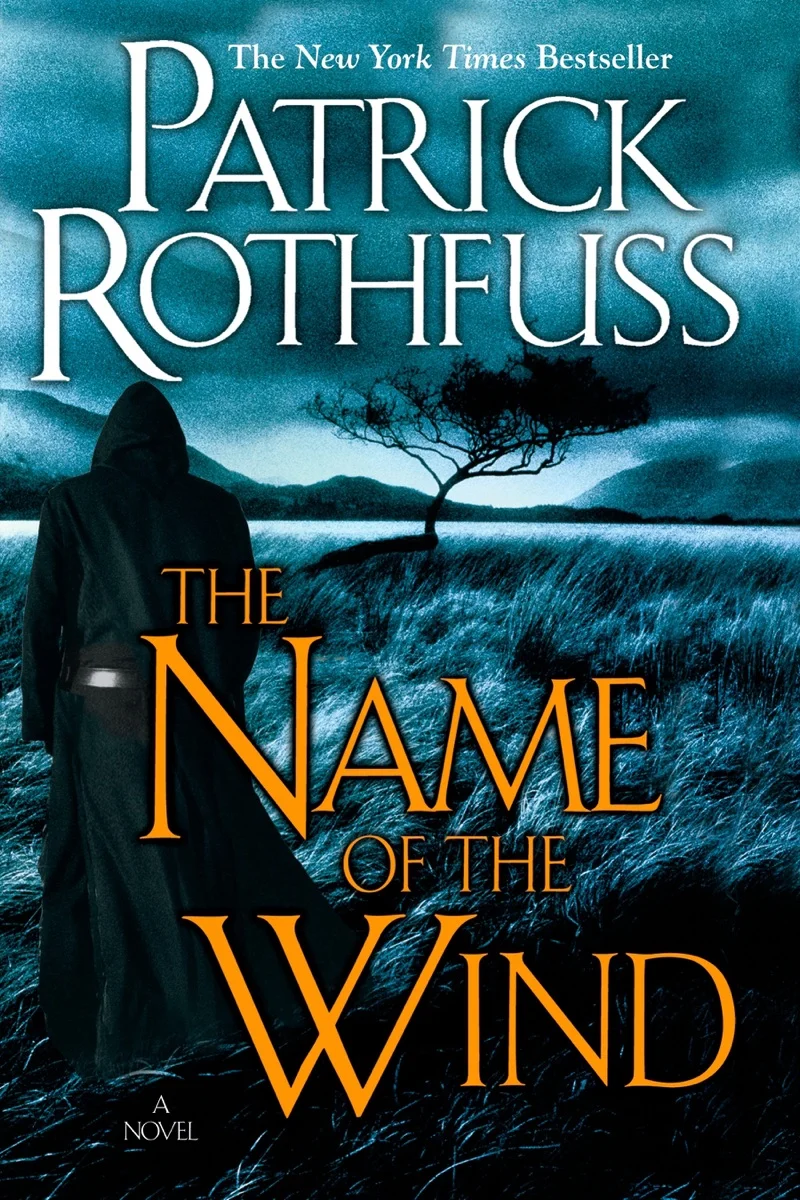
The Name of the Wind
A famous hero is hiding as an innkeeper, and finally agrees to tell his own story over three days
Chapter IAbout the book
- First published
- 2007
- Main genre
- Fantasy
- Length
- 662 pages
A legendary magician, musician and thief is running an inn under an assumed name, and he has finally agreed to tell the true story of his life to a man who writes it down. The Name of the Wind is the first book of The Kingkiller Chronicle, told as a frame story. In the present Kvothe keeps an inn in a quiet town, and the long oral autobiography he dictates fills three days. The frame is told in the third person, while his own account is told in the first. Kvothe is the one the tales call a hero, an assassin and a killer of kings, and he insists the stories have turned him into something he is not. In his telling he grows up among a troupe of travelling performers, loses them, and survives on the streets before he reaches the University, where the story of the arcane arts and its mysteries really begins. Publishers Weekly called the book self-aware heroic fantasy: it plays with the conventions, with an unreliable hero and a world in which stories matter as much as swords. The frame also hints at a darker present, because the inn itself feels like a place of hiding.
Chapter IIThe author and the making
Patrick Rothfuss was born on June 6, 1973. He took a BA in English at the University of Wisconsin–Stevens Point in 1999 and a master's degree at Washington State University in 2002. He started the book in 1994, and the story took a long time to take shape: he finished a first draft of the whole trilogy in 2000, which he later called a hot mess, and by one account it took 15 years to shape his first novel from an initial draft. A turning point came in 2002: he won the Writers of the Future contest with “The Road to Levenshir,” an excerpt from what became The Wise Man's Fear. After the contest he worked with the writer Tim Powers and with an agent, who helped him revise the first third of the trilogy, and that third became The Name of the Wind. He sold the book to DAW Books in 2006, and DAW published it on March 27, 2007, as a 662-page hardcover. When it came out, the trilogy was already completely written, and the next two books were planned for one-year intervals. In 2008 he founded Worldbuilders, a charity that has raised over $11.5 million, mainly for Heifer International.
Chapter IIIHow it was received
Publishers Weekly welcomed the debut as self-aware heroic fantasy from a first-time novelist. The series is described as critically acclaimed, and George R. R. Martin called the sequel, The Wise Man's Fear, his favourite fantasy novel of 2011. That book topped the New York Times bestseller list in 2011, and the series has sold over 10 million copies. The sharpest complaint is not about the prose but about the wait. Rothfuss promised the next two books on an annual schedule, but revisions delayed The Wise Man's Fear until March 2011. The third book, The Doors of Stone, was unpublished as of 2026. In July 2020 his editor, Betsy Wollheim, said she had never seen a word of book three. In December 2021 he apologised for the delay and promised to share a full chapter if his charity reached a goal, and in April 2022 he said the process was moving more slowly than he would like. The screen rights have had a tangled history: 20th Century Fox optioned the series for television in July 2013, and the rights reverted to Rothfuss in October 2017. Showtime ended its involvement in September 2019, and Lin-Manuel Miranda confirmed in 2022 that he had left the project.
Chapter IVWhy it matters
The Name of the Wind matters as a debut that made a case for slow, voice-driven fantasy. Its frame lets Rothfuss do two things at once: tell the adventure and question what a legend does to the person it is about. A reader should know the cost before starting. The series is unfinished, and the third book has no release date, so the book may be the start of a story that never ends in print. Its pace is deliberate, with long stretches at the University that favour worldbuilding and magic-system detail over plot. It suits readers who enjoy lyrical prose, music and a frame-story structure, and it is a poor fit for those who need a completed trilogy. The reading decision is yours, but expect to wait. Rothfuss's charity work through Worldbuilders is part of his story too, and shows how the book's readers have been mobilised beyond the page.
Chapter VIf you liked this
- A Wizard of Earthsea Ursula K. Le GuinA young magician's training and the cost of names, in a more compact book
- The Lies of Locke Lamora Scott LynchA clever, streetwise protagonist and a vivid city, with a sly narrative voice
- The Eye of the World Robert JordanEpic fantasy that begins with a village youth pulled into a larger world
- Jonathan Strange and Mr Norrell Susanna ClarkeFantasy that treats magic and storytelling as a scholarly tradition
- Fantasy
- Adventure
- Coming-of-age
Buying links are coming soon.