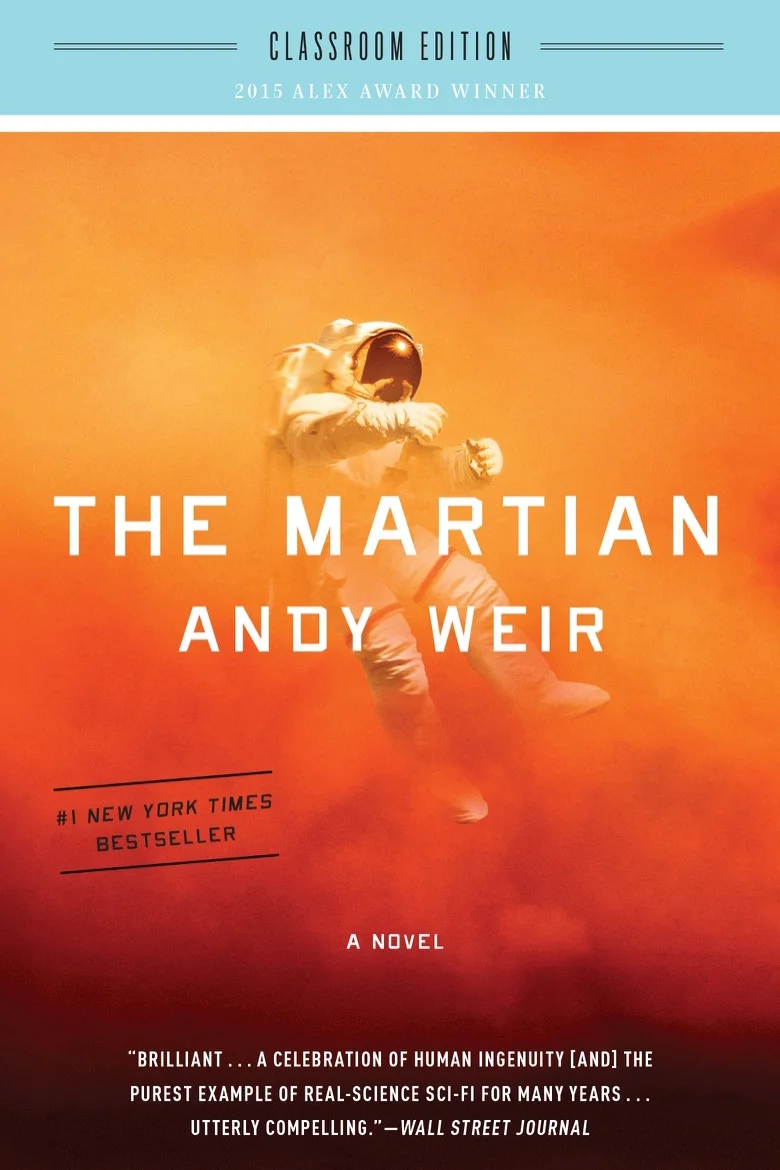
The Martian
An astronaut stranded alone on Mars has to solve one problem at a time to stay alive
Chapter IAbout the book
- First published
- 2011
- Main genre
- Science fiction
An astronaut is stranded on Mars after a dust storm, and he has to work out, with math, how to survive until anyone can reach him. The Martian is an updated version of the castaway tradition behind Robinson Crusoe, and its problems are solved on the page with arithmetic. Calculations show that his food supply will run out, and growing food would take hundreds of liters of water; for water, Weir relied on hydrazine rocket fuel, which yields water, and on a lot of online searching about how hydrazine engines work. Weir set himself a rule that no magical technology would be allowed, and he compared his approach to that of Larry Niven's Ringworld, which also includes checkable math. The novel uses Mawrth Vallis for navigation, a location that appeared on the shortlist for the Curiosity rover's landing site after the e-book was released. Weir, a self-described “space dork”, wrote it for readers who enjoy exactly this kind of problem.
Chapter IIThe author and the making
Andy Weir was a full-time programmer for 25 years and had spent about 10 years writing fiction and web comics, building a readership of roughly 3,000 regular readers, when he began posting The Martian in 2009 as a free serial on his website. He posted a chapter every six to eight weeks, and scientifically minded readers, including chemists, pointed out problems in early drafts, which he revised. Fans then asked for an e-book, and he put a Kindle edition on Amazon at $0.99, the lowest price allowed, where it reached the top of Amazon's science fiction bestseller list. A book agent contacted him, then an editor at Random House's Crown imprint, and a film deal followed within days. About 11 months before Crown's print release, Weir signed with Podium Publishing for the audiobook, and Crown later edited the novel, which changed some content and the ending. He has said: “You don't need to actually be right, you just need to sound right.” He deliberately kept one inaccuracy, the dust storm that strands the astronaut, because a realistic wind would not have been dramatic enough.
Chapter IIIHow it was received
Crown released the print edition in February 2014, and the hardcover debuted at number 12 on the New York Times hardcover fiction list; by January 5, 2015, it was number 10 on the Times fiction list. The audiobook, narrated by R.C. Bray and published by Podium, was a top-selling title on Audible and won a 2015 Audie Award for Best Science Fiction. The Washington Post reported that the book and film deals were in the low to mid six figures. Ridley Scott directed the film, starring Matt Damon and Jessica Chastain, and 20th Century Fox acquired the rights in the same week that the Crown deal closed. Weir reacted with disbelief: “I actually worried it could all be an elaborate scam.” Of the film deal he said: “My job was basically to cash the check.” He described himself as playful about his luck, and said: “I write about brave people but I'm not one of them.”
Chapter IVWhy it matters
The Martian matters as the most prominent example of a self-published book finding its readers online and then reaching the bestseller list and the cinema. It began as a free serial for roughly 3,000 regular readers, improved because those readers corrected its science, and became a Kindle bestseller before a publisher bought it. It also made hard-science problem solving the engine of a mainstream thriller. The honest reservation is that the science is more persuasive than it is exact. Weir said you don't need to actually be right, you just need to sound right, and he kept the opening dust storm inaccurate because a realistic wind would not have been dramatic enough. Its hardcover debuted at number 12 on the New York Times list, a long way from its start as a free web serial. It suits readers who enjoy problem-solving, practical detail and a cheerful, nerdy narrator, and it is a poor fit for those who want deep character studies or a literary style.
Chapter VIf you liked this
- Project Hail Mary Andy WeirWeir's later novel, another lone-scientist survival story
- Ringworld Larry NivenThe hard-science novel Weir compares his approach to
- Robinson Crusoe Daniel DefoeThe castaway story that The Martian updates
- Seveneves Neal StephensonA long, technical story of survival in space
- Science fiction
- Adventure
- Comedy
Buying links are coming soon.