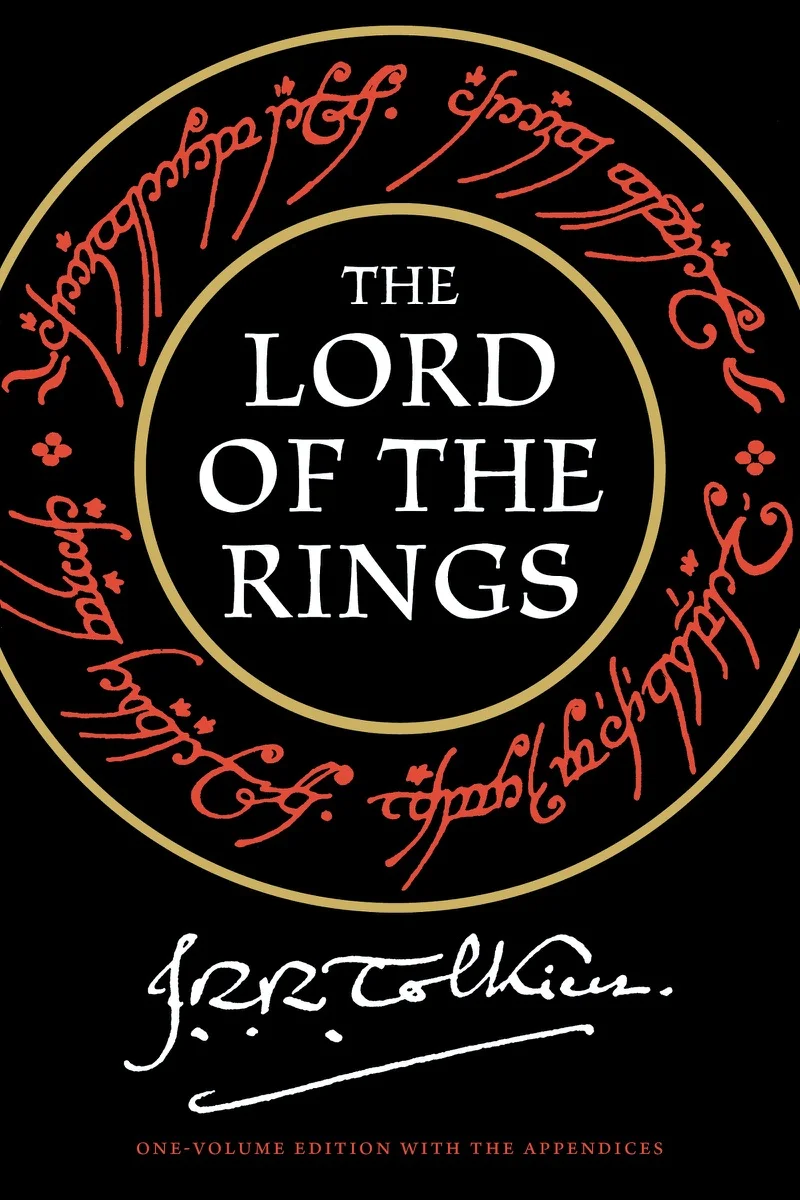
The Lord of the Rings
A sequel to a children's story that grew over years into the model for modern fantasy
Chapter IAbout the book
- First published
- 1954
- Main genre
- Fantasy
A quiet hobbit inherits a ring that the most feared lord in the world wants back, and the safest course is to carry it as far from home as he can. The Lord of the Rings begins in the Shire, a sleepy country of gardens, on the day Bilbo Baggins vanishes from his own birthday party. Bilbo leaves his house, his comfortable life and a plain gold ring to his young cousin Frodo, and the wizard Gandalf, after years of study, comes back to tell Frodo what the ring is. From there the book becomes a journey: Frodo and his friends leave the Shire on foot, are hunted by the sinister Black Riders, and meet strange allies on the road, among them a ranger who is known in Bree only as Strider. Tolkien tells it in plain, steady English, with songs and poems set into the prose, maps, invented languages and a long history behind every ruin. It was published in three volumes, but Tolkien thought of it as one story. It is also a sequel to The Hobbit, and the opening chapters keep a lighter, domestic tone before the shadow grows.
Chapter IIThe author and the making
The book began as a request. After The Hobbit succeeded in 1937, publishers persuaded Tolkien to begin a new Hobbit in December 1937. He first planned a tale about Bilbo running out of treasure and seeking more adventure, but the story took an unpremeditated turn when the Black Riders entered it, as he wrote in a 1938 letter. The meaning of the Ring and the reasons for Bilbo's disappearance were not settled until spring 1938, and by 1941 it was still unclear how the Ring would be destroyed. The ranger now called Aragorn began as Trotter, a wild hobbit in wooden shoes, and was replaced in turn by Ingold and Elfstone before Aragorn took the part. Tolkien held a full-time academic post and marked exams for extra money, and in 1940 he worked mostly by night. From April 1944 he wrote the story as a serial for his son Christopher, who was serving with the Royal Air Force in South Africa and received chapters as they were finished. He showed the manuscript to his publishers in 1947, and Stanley Unwin's 12-year-old son Rayner was asked to read an early chapter; Rayner had recommended The Hobbit. The story was effectively finished in 1948, revisions of the earlier parts were done in 1949, and Tolkien had spent more than ten years on the main narrative and appendices. The Fellowship of the Ring and The Two Towers were printed in 1954, and The Return of the King in October 1955.
Chapter IIIHow it was received
The first reviews were divided but often extravagant. C. S. Lewis wrote that “here are beauties which pierce like swords or burn like cold iron,” W. H. Auden was among the admirers, and Edwin Muir wrote in The Observer in 1954 that however one may look at it, The Fellowship of the Ring is an extraordinary book. Muir was colder about the last volume in 1955, writing that “All the characters are boys masquerading as adult heroes.” The sharpest attack came from Edmund Wilson in The Nation on April 14, 1956, under the title “Oo, Those Awful Orcs!” He called it a children's book which had somehow got out of hand, said Tolkien had little skill at narrative and no instinct for literary form, and dismissed it as balderdash. Philip Toynbee predicted in 1961 that it had passed into a merciful oblivion, and later critics, including Germaine Greer and Harold Bloom, kept the argument alive. Readers, though, did not agree. The Ace and Ballantine paperbacks made it a hit with a new generation in the 1960s, and by 2001 it had sold about 50 million copies. In a 1996 Waterstone's poll of 26,000 readers it was named book of the century, and in 2003 the BBC's Big Read named it the nation's best-loved book.
Chapter IVWhy it matters
The Lord of the Rings matters because its reputation had to be argued for, and the argument is part of its interest. Scholars gave it academic respectability from Paul Kocher's Master of Middle-Earth in 1972, followed by Tom Shippey's The Road to Middle-earth in 1982 and Verlyn Flieger's Splintered Light in 1983, and in 2003 Brian Rosebury reassessed it as a tightly constructed work. Tolkien Studies was founded in 2004. Greer's remark that it had been her nightmare that Tolkien would turn out to be the most influential writer of the twentieth century is, in its own way, a measure of reach. Expect to meet the book's weaker side too. Critics have called the prose unbearably archaic, Michael Moorcock called it the prose of the nursery-room, and Catherine Stimpson described the characters as irritatingly, blandly, traditionally masculine. The pace is slow in the first volume, the poems are many, and the appendices are long. It suits readers who want a fully imagined world and are happy to wander, and it is a poor fit for those who want fast, modern prose. It stands as one story, and the volumes are best read in order; the published split into three is a matter of publishing, not of form.
Chapter VIf you liked this
- The Hobbit J. R. R. TolkienThe shorter, lighter book that the Lord of the Rings grew out of as a sequel
- A Wizard of Earthsea Ursula K. Le GuinA compact fantasy with a carefully invented world and a quieter tone
- The Eye of the World Robert JordanEpic fantasy that begins with a village youth and a pursuing darkness
- The Once and Future King T. H. WhiteAn English fantasy of legend and kingship from the same era
- Fantasy
- Epic
- Adventure
Buying links are coming soon.