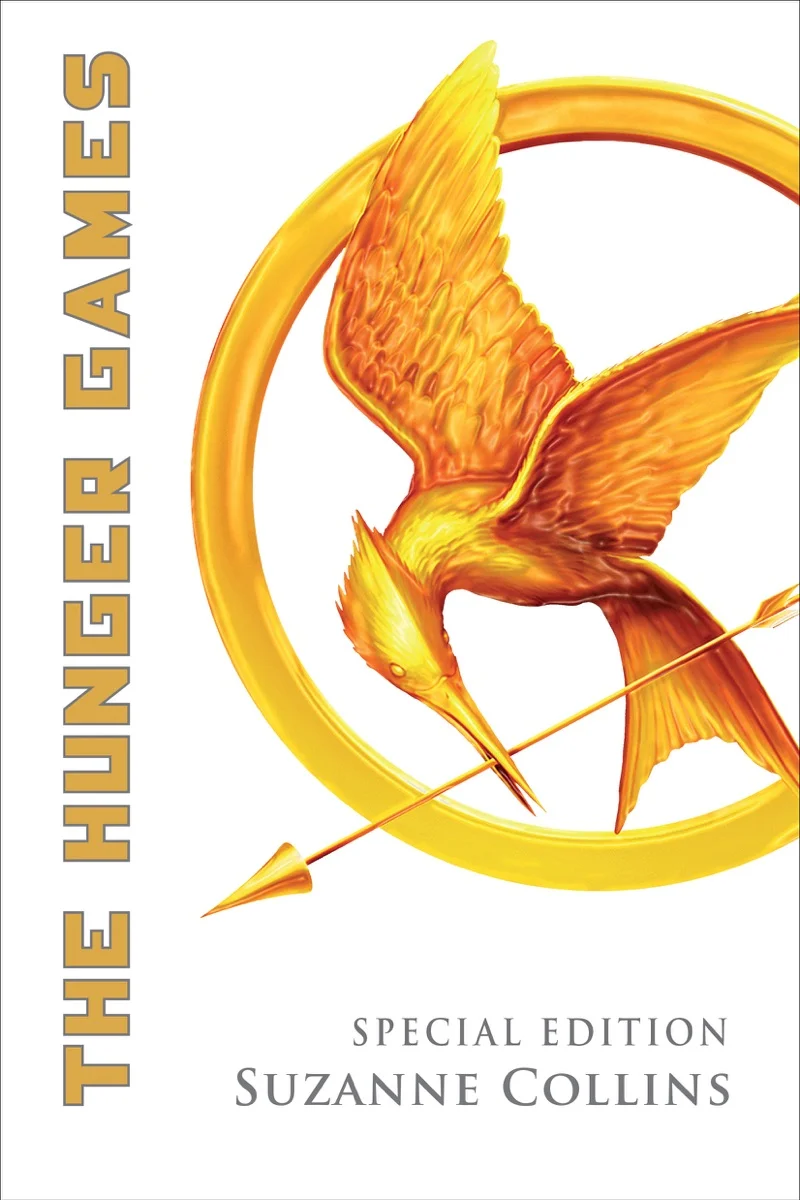
The Hunger Games
In a nation that stages a televised fight to the death between children, one girl volunteers to take her little sister's place
Chapter IAbout the book
- First published
- 2008
- Main genre
- Dystopian fiction
- Length
- 374 pages
Katniss Everdeen, a 16-year-old from District 12, lives in Panem, a post-apocalyptic nation built on the remains of North America. When her 12-year-old sister Primrose is chosen by lottery, Katniss volunteers to take her place in the 74th Hunger Games, a televised fight to the death. One boy and one girl are taken from each district, and Katniss's fellow tributes include Peeta Mellark, a former schoolmate. Panem has thirteen districts, a nod to the thirteen colonies, and Collins links the Games to “Bread and Circuses”, the idea that food and entertainment lull people into giving up political power. Katniss narrates in the first person, and Collins has said the first page came out that way even though she had planned third person: “Step aside, this is my story to tell.” She thought of the book first as “a war story”, with the dystopia second. The first hardcover from Scholastic runs to 374 pages.
Chapter IIThe author and the making
Suzanne Collins has said the idea came to her while she was channel surfing between reality television and footage of the Iraq War, when “the lines began to blur in this very unsettling way”. She was finishing the fifth Underland Chronicles book at the time. The Greek myth of Theseus was a major source: “in her own way, Katniss is a futuristic Theseus”, she said, and Roman gladiator games supplied the framework. Her father, a career Air Force specialist, historian and doctor of political science, was away for a year in Vietnam when she was a child, and he wanted his children to understand why a battle occurred, how it played out and its consequences; his knowledge of wild plants helped inform her survival details. The name Katniss came from the arrowhead plant. Collins said she had not heard of Koushun Takami's 1999 novel Battle Royale, which has similar elements, until after her manuscript was submitted, and her editor advised her not to read it. Scholastic published the first hardcover in the United States on September 14, 2008, with a first printing of 50,000 that was increased twice to 200,000.
Chapter IIIHow it was received
The Hunger Games was a publishing phenomenon. It entered the New York Times bestseller list in November 2008 and stayed for over 100 consecutive weeks, had sold 800,000 copies by February 2010 and over 17.5 million by March 2012, and was translated into 26 languages. Reviews were warm but not uniform. John Green in the New York Times called it “brilliantly plotted and perfectly paced”, though he felt its allegorical potential was underused. Stephen King in Entertainment Weekly gave it a B and noted “authorial laziness” that kids would accept more readily than adults. Laura Miller in The New Yorker found the stated premise, that the Games are a propaganda punishment, unconvincing and thought the story worked better as an allegory of high school social life. Kirkus praised its action and world-building but criticised the copyediting of the first printing. The reviewer William Peace found it “horrific and at the same time compulsively compelling”, but thought the creatures in the final arena scene were too much. Parents challenged it: it ranked fifth on the American Library Association's most challenged list for 2010, citing “unsuited to age group” and “violence”. It won the Golden Duck Award in 2009 and the California Young Reader Medal in 2011. The film, directed by Gary Ross, was released on March 23, 2012, with Jennifer Lawrence as Katniss, and opened to a record $152.5 million in North America for a non-sequel.
Chapter IVWhy it matters
The Hunger Games matters because it made young adult dystopia a mainstream publishing category and brought a hard question to a young audience: what happens when a society turns violence into entertainment. Collins said she saw it as a war story and hoped readers would debate the ethics of war and violence, and her link between reality television and war footage was an early version of a worry that has only grown. The honest reservations come from its own critics. King saw laziness in places, Miller doubted the logic of the Games, and Peace found parts of the ending excessive. The violence also puts it on lists of challenged books. It suits readers who want a fast, emotionally direct survival story with a strong first-person voice, and it is a poor fit for anyone who wants a carefully worked-out political world or who dislikes violence involving young characters. At 374 pages in hardcover it is not long, and it is the first book of a trilogy.
Chapter VIf you liked this
- Battle Royale Koushun TakamiA 1999 novel with a similar premise, darker and more graphic
- The Long Walk Stephen KingA deadly contest staged for an audience, linked to the book by King himself
- The Giver Lois LowryA young-adult dystopia about a society that hides its costs
- Ender's Game Orson Scott CardA child pushed into a violent system built by adults
- Dystopian fiction
- Adventure
- Science fiction
Buying links are coming soon.