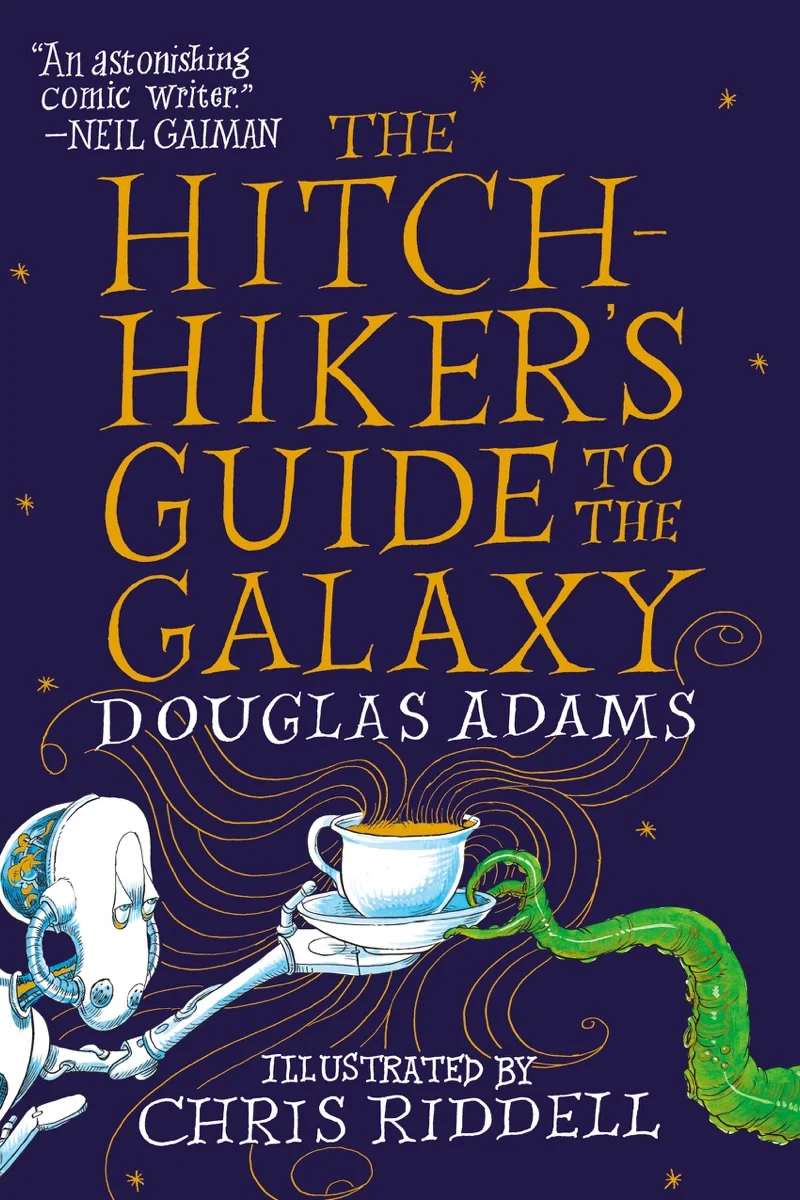
The Hitchhiker's Guide to the Galaxy
Earth is demolished for a bypass, and an Englishman in a dressing gown is rescued by a friend who is really an alien
Chapter IAbout the book
- First published
- 1979
- Main genre
- Science fiction
Just before Earth is demolished to make way for a hyperspace bypass, a hapless Englishman is rescued by a friend who is really an alien. The Hitchhiker's Guide to the Galaxy follows Arthur Dent and Ford Prefect, a researcher for the Guide, as they hitch a lift on a passing spaceship. The destroyers of the planet are the Vogons, a race of unpleasant and bureaucratic aliens, and the novel's first joke is that Earth's fate is announced on a notice that nobody on the planet had bothered to read. Arthur has no idea where he is or why his friend has been hiding what he is, and Ford, who has been stuck on Earth for years, uses the Guide, a bestselling electronic encyclopedia, as his source for everything. The book is told in a dry, conversational narrator's voice that wanders off into footnote-like asides, definitions and absurd statistics, and its plot is deliberately loose, hopping from one disaster to the next while the narrator keeps a straight face. It is a comedy first and a space adventure second, and it began its life as a radio programme, which shows in its brisk, episodic scenes.
Chapter IIThe author and the making
The idea, Douglas Adams said, came in 1971, when he was hitchhiking from London to Istanbul with a copy of the Hitch-hiker's Guide to Europe and lay drunk in a field near Innsbruck. When the stars came out, he wrote, he thought that someone ought to write a Hitchhiker's Guide to the Galaxy. He later said that his memory of the moment had been reconstructed over years of retelling, and friends recalled him mentioning the idea in Greece in 1973. He only developed it in 1976, and in February 1977 the BBC producer Simon Brett met him at a Chinese restaurant near Broadcasting House and helped him narrow many ideas to one: a science fiction comedy in which each episode ends with the destruction of Earth. The first outline's hero was called Aleric B., later crossed out and replaced with Arthur Dent. The BBC gave the go-ahead in June 1977, and Adams was paid £180 per script. Recording finished on 3 March 1978, and the first episode aired five days later, at 10.30pm on Radio Four. Pan Books published the novel in September 1979, after the BBC declined publishers' overtures on the grounds that books of radio shows do not sell. As for the number 42, Adams said it was a joke, an ordinary, smallish number he wrote down at his desk. He also said: “I love deadlines. I love the whooshing sound they make as they go by.”
Chapter IIIHow it was received
The radio series, which began on 8 March 1978, received generally good reviews and a tremendous audience reaction for radio, with little BBC promotion; its success became clear to its producer when a fan letter arrived addressed to Megadodo Publications, Megadodo House, Ursa Minor. The novel reached number one on the book charts in its second week and sold over 250,000 copies within three months. It reached a million copies by 1984, and by 2005 the first novel alone had sold over 14 million copies and been translated into more than 30 languages. It ranked fourth in the BBC's Big Read poll. Not everything Adams touched worked. The 1980 stage show at the Rainbow Theatre was widely panned and closed early, losing a lot of money, and the 2005 film, released on 28 April 2005, was only a modest success, opening to $21 million in the US. The six-episode BBC television series aired on BBC 2 in January and February 1981. Adams himself settled the spelling of the title as one word, Hitchhiker, in 2000.
Chapter IVWhy it matters
The Hitchhiker's Guide to the Galaxy matters as the book that made comedy a respectable mode for science fiction, and as an example of a story that moved from radio to print to stage, television and film without losing its voice. Its running jokes, the answer of 42 and the advice not to panic, have become shared references well beyond the genre, and the Guide's entries, with their dry authority, turned the encyclopedia into a comic device. It also demonstrates how an oral, episodic form can shape a novel: the scenes are short, the pace is quick and the narrator never stops talking. Know what you are getting. The plot is loose, the characters are sketches and the book is built on jokes, so a reader looking for deep characters or a tight plot will find less than the fame suggests. It is short and a light read, it is a good fit for readers who enjoy dry British humour and absurd logic, and it is a poor fit for those who want serious science fiction. It was the first of five books, but it stands alone well enough as a comic novel, and the later volumes get steadily stranger.
Chapter VIf you liked this
- Good Omens Terry Pratchett and Neil GaimanBritish comic fantasy with the same dry narrator and apocalyptic jokes
- The Colour of Magic Terry PratchettThe first Discworld book, with a comic tour of a strange universe
- Slaughterhouse-Five Kurt VonnegutA short, funny and sad science fiction novel with an unusual narrator
- The Restaurant at the End of the Universe Douglas AdamsThe direct sequel, continuing Arthur and Ford's journey
- Science fiction
- Comedy
- Satire
Buying links are coming soon.