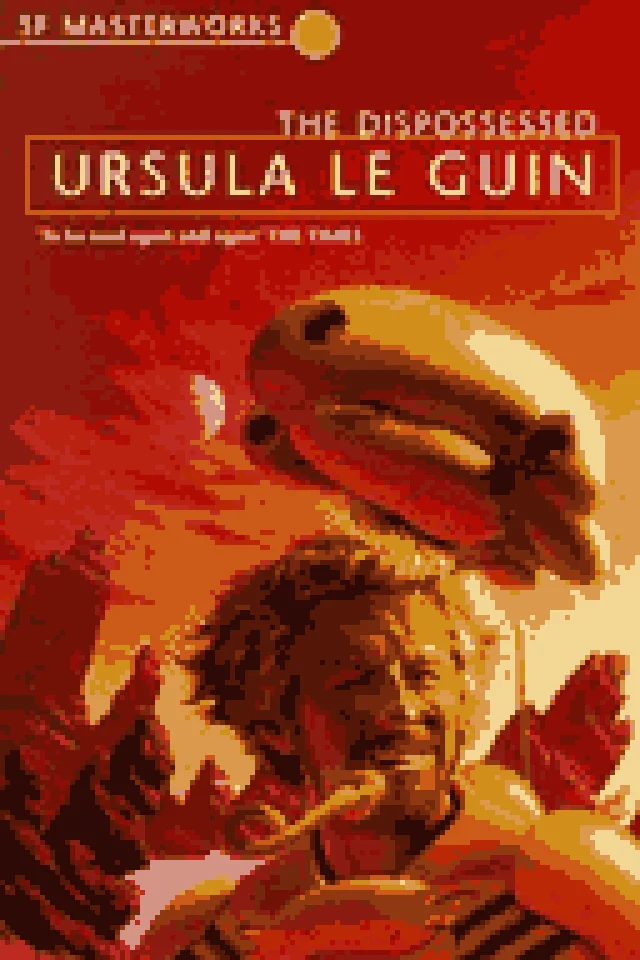
The Dispossessed
A physicist from a moon without property or government travels to the capitalist planet his people left behind
Chapter IAbout the book
- First published
- 1974
- Main genre
- Science fiction
- Length
- 341 pages
Shevek, a physicist on the anarchist moon Anarres, is developing a General Temporal Theory that a jealous superior can keep from publication. The Dispossessed alternates between his life on Anarres and his journey to Urras, the planet its settlers left about 170 years earlier. Anarres is a society run on anarcho-syndicalist principles, with no property, government or formal laws, and the major states of Urras guaranteed the settlers non-interference when they left. Urras is divided into states dominated by two rival superpowers, A-Io and Thu, and Shevek travels to A-Io, a capitalist and patriarchal state. The two worlds are kept apart by mutual agreement, and Shevek is an outsider on both: too committed to the ideals of Odo for the bureaucracy growing on Anarres, and repelled by the inequality he sees on Urras. The romance between Shevek and Takver runs through the book as its most personal thread. On Anarres, hidden power structures block his work, and on Urras rival governments try to exploit his research.
Chapter IIThe author and the making
Ursula K. Le Guin wrote The Dispossessed in 1973 for publication in May or June 1974. It began as a short story that she later counted among her weakest in 30 years of writing, but its main character survived the rewrite and became the novel's guide; in her 2017 introduction for the Library of America she wrote, “There was a book in it, and I knew it.” Her opposition to the Vietnam War had led her to study peace, and she read utopias, pacifism, Gandhi and the nonviolent anarchists, especially Peter Kropotkin and Paul Goodman. She said J. Robert Oppenheimer was the model for Shevek, and a letter she sent credits Murray Bookchin's Post-Scarcity Anarchism, published in 1971, for many of the philosophical and ecological ideas. She called the result “a heavy, argumentative book”. Harper & Row published it in 1974, in a first-edition hardcover of 341 pages. The first edition carried the tagline “The magnificent epic of an ambiguous utopia!”, which fans shortened to “An ambiguous utopia” and which some editions adopted as a subtitle.
Chapter IIIHow it was received
The Dispossessed won the Hugo, Nebula and Locus awards for best novel, one of a small number of books to win all three; the Hugo and Locus were awarded in 1975. It came second in the 1975 John W. Campbell Memorial Award, behind Philip K. Dick's Flow My Tears, the Policeman Said, and won the Libertarian Futurist Society's Hall of Fame award in 1993. Reviewers praised its invented society. Gerald Jonas in The New York Times thought it so persuasive that it ought to stop the writing of prescriptive utopias, and Theodore Sturgeon called it “a beautifully written, beautifully composed book”. Lester del Rey gave a mixed review, praising the writing but arguing that the ending “slips badly”. Critics also found faults: Nicholas Whyte noted heavy, argumentative prose and little sense of wonder, Josh Wimmer in Gizmodo objected to “the black-and-whiteness of the picture Le Guin paints”, and Sarah LeFanu argued that the female characters seem secondary to the male protagonist, a point on which critics disagree. Tom Moylan described it as the most popular of the critical utopias of the 1970s. CBC Radio's Vanishing Point adapted it in 1987 as six 30-minute episodes, and on October 5, 2021, 1212 Entertainment and Anonymous Content announced a limited series.
Chapter IVWhy it matters
The Dispossessed matters because it treats utopia as a problem rather than a destination. Tom Moylan placed it among the “critical” utopias, which keep the difference and imperfection of a utopian society in view, and the book shows its anarchist society with its flaws: selfishness, hierarchy and bureaucracy creep back into Anarres over time. Gerald Jonas's remark that it should stop the writing of prescriptive utopias sums up its standing, and later novels such as Iain M. Banks's Culture series and Samuel R. Delany's Trouble on Triton share its interest in utopia's discontents. It also remains a reference point for readers curious about anarchist ideas, since it presents them through a lived society rather than a manifesto. The reservations are real. Le Guin herself called it a heavy, argumentative book, the Soviet-like state of Thu is the least developed society in it, and some readers find its picture of the two worlds too simple. It suits readers who enjoy novels of ideas and slow, thoughtful science fiction, and it is a poor fit for anyone who wants spaceships, wonder or fast plotting.
Chapter VIf you liked this
- The Left Hand of Darkness Ursula K. Le GuinLe Guin's other landmark Hainish novel, about gender, politics and trust
- Trouble on Triton Samuel R. DelanyAnother critical utopia, concerned with utopia's discontents
- The Player of Games Iain M. BanksA Culture novel that looks at a utopia from outside
- Utopia Thomas MoreThe founding text of the genre that Le Guin argues with
- Science fiction
- Political fiction
- Philosophical fiction
Buying links are coming soon.