The Covenant of Water
A girl married at twelve, a family where someone in every generation drowns, and a doctor's century in Kerala
Chapter IAbout the book
- First published
- 2023
- Main genre
- Historical fiction
- Length
- 736 pages
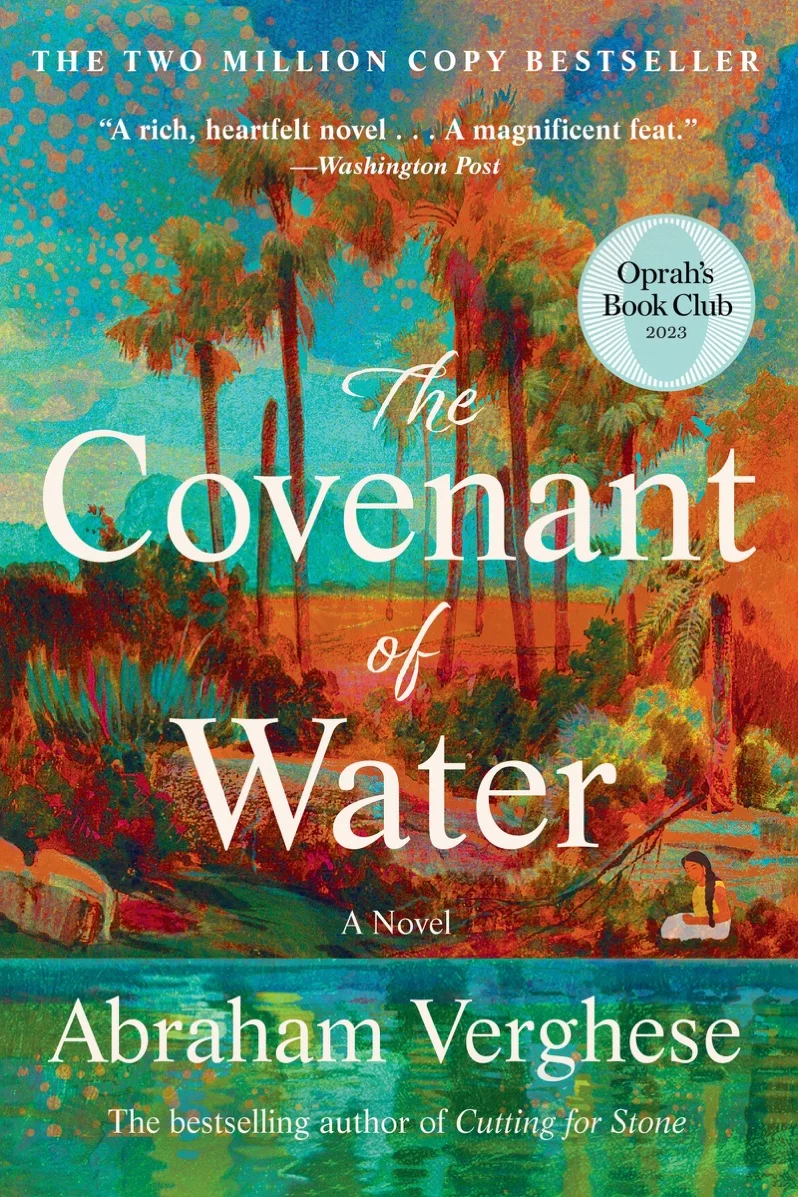
A twelve-year-old girl is sent across Kerala to marry a man of forty, and in every generation of the family she joins someone drowns. The Covenant of Water opens in 1900 on the Parambil estate and follows three generations of an Indian Christian family until the 1970s. Mariamma travels to Parambil for an arranged marriage to a widower, a man of forty, and she arrives as a child in a house of water, rice and slow rivers. The family calls the pattern of drownings The Condition, and the book treats it as a mystery that science will need generations to understand. Around Parambil it spreads outward to take in the medicine, politics and religion of a region and a century, with a doctor's eye for the body and its failures. Verghese writes in a patient, third-person voice that moves between households, so that a marriage in one chapter and a surgery in another belong to the same story. Water runs through it as the thing that gives life and takes it. The publisher called it a hymn to progress in medicine and to human understanding.
Chapter IIThe author and the making
Abraham Verghese is a physician and has said, “I love medicine and identify as a physician.” His debut, Cutting for Stone, appeared in 2009 and followed twin brothers born in Ethiopia, and The Covenant of Water returns to its themes of history, medicine, culture and family. The seed was a notebook. About ten years before the interview, he found one his mother had written for a granddaughter: when his niece asked, his mother, then in her 70s, wrote the story of her life in elegant longhand. He did not use those stories directly, but they were a reminder of the richness of the community. He had spent holidays in Kerala as a boy without thinking much about it. He then made several trips to Kerala, where relatives and friends helped with history, politics and religion, and he tracked the story against world history on a spreadsheet and a whiteboard. He has called geography the biggest decision in a novel, because everything follows from it. The plot kept changing, so the whiteboard went through many iterations. He wrote the bulk of the novel during Covid, and the final draft was 50,000 words shorter than earlier versions. His editors were willing to read an 800-page manuscript over the holidays. Grove Atlantic published the 736-page novel in 2023.
Chapter IIIHow it was received
Oprah Winfrey chose it as her 101st Book Club pick, announced on May 10, 2023, calling it epic and transportive and writing, “I couldn't put the book down until the very last page.” Reviews were largely positive. Jenny Bhatt in NPR praised how Verghese threads meaningful connections between macrocosmic and microcosmic details, and Joan Frank in The Washington Post wrote that the further into the novel readers sink, the more power it accrues. Andrew Solomon in The New York Times was more reserved. He found the book lacked Indian cultural subtleties, calling it exotic by local standards but substantially softened for the locals, and said it focuses almost entirely on good people to whom many terrible things happen. He wrote that he did not entirely believe in the characters but was moved by how much the author loves them. Oprah said it ranks among the finest books she has read. The publisher, Grove Atlantic, promoted it as a hymn to progress in medicine and to human understanding, and many readers took it as a sequel in spirit to Cutting for Stone.
Chapter IVWhy it matters
The Covenant of Water matters as a long, old-fashioned family saga that puts medicine at its centre without turning it into a procedural. Verghese is a doctor, and the book treats the body, disease and the slow growth of medical knowledge as part of a region's history, so a reader meets the science of its time through the people who practice it. It also gives a wide readership a picture of Kerala's Christian community, its customs and its century, drawn from his own family's stories. The structure, in which an affliction runs through generations, gives the book a pulse that carries it through its length. Expect a big book. At 736 pages it asks for patience, it spreads across many characters and decades, and Solomon's complaint that it focuses almost entirely on good people, to whom many terrible things happen, is worth holding against it, as is his remark that he did not entirely believe in the characters. It suits readers who like generational novels, medical detail and a strong sense of place, and it is a poor fit for those who want a quick plot or morally ambiguous characters. Readers of Cutting for Stone will recognise the voice, though the book stands alone.
Chapter VIf you liked this
- Cutting for Stone Abraham VergheseHis first novel, a medical family saga that begins in Ethiopia
- The God of Small Things Arundhati RoyA Kerala family novel told with water, memory and a keen sense of place
- A Fine Balance Rohinton MistryA large, humane Indian novel that follows ordinary lives across a turbulent period
- Homegoing Yaa GyasiA multi-generational saga that follows one family across centuries and continents
- Historical fiction
- Literary fiction
- Realism
Buying links are coming soon.