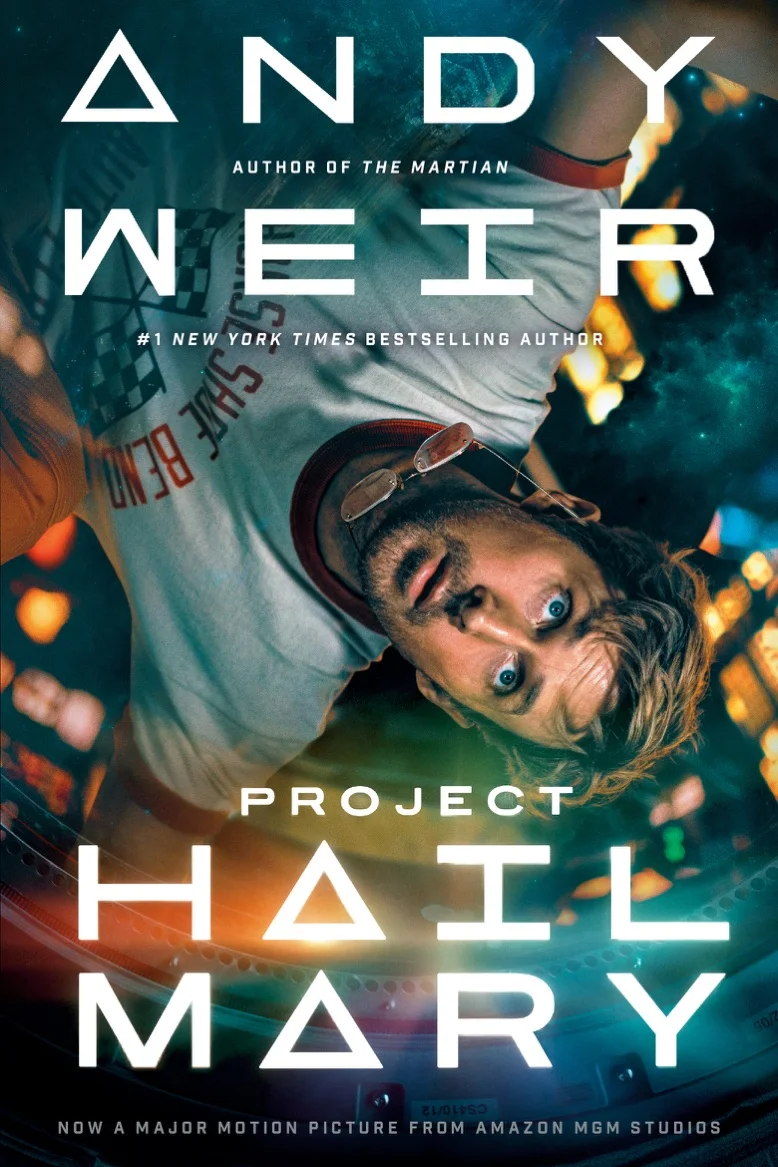
Project Hail Mary
A man wakes alone on a spaceship with no memory, and the Sun is dimming
Chapter IAbout the book
- First published
- 2021
- Main genre
- Science fiction
- Length
- 496 pages
A man wakes alone on a spaceship with no memory of who he is or why he is there, and the Sun is dying. Project Hail Mary opens with Ryland Grace emerging from an induced coma aboard the interstellar craft Hail Mary, with amnesia and a puzzle to solve before he can save anyone. Grace is a former biologist who had been teaching junior high school. Back on Earth, scientists have watched the Sun dim at an accelerating rate, which threatens a catastrophic ice age within thirty years, and governments give a formidable official, Eva Stratt, near-unilateral authority to find a solution. A microorganism that Grace studies and names Astrophage turns out to be both the cause of the dimming and, as an energy-absorbing fuel, the key to travel between stars, and he is drawn onto the crewed Hail Mary mission. The book is told in the first person, and Grace's memory returns in flashbacks that alternate with his present in space, so the reader learns what he knows as he remembers it. Weir keeps the focus on problem solving: what can be measured, what it means, and what to try next. The mood is closer to a lively lesson than to a lonely survival tale.
Chapter IIThe author and the making
After The Martian, Andy Weir began a space opera called Zhek and wrote 75,000 words before abandoning it for Artemis, published in 2017. Some of Zhek survived: a ruthless bureaucrat and an energy-absorbing fuel substance moved into Project Hail Mary. Weir wanted humans to find a fuel that converts matter into energy, felt that a mad-scientist inventor was unconvincing, and decided the idea sounded biological. He has described Astrophage as basically mold that lives on stars, and he chose Tau Ceti on purpose because it is a very old star; to avoid inventing several kinds of life from the ground up, he decided there had been a panspermia event. He says research is by far the most fun part for him, that he does not like writing but likes having written, and that more research went into this book than into his previous two, because if he got something wrong no one could tell him until it was in print. He finished the first draft in January of 2020, and he says he tends to write feel-good novels. Ballantine Books published it on May 4, 2021, as a 496-page hardback, and Ray Porter narrated the audiobook.
Chapter IIIHow it was received
The novel debuted at No. 3 on the New York Times combined print and e-book fiction list in May 2021, and it reached No. 1 on the Locus hardcover list in August 2021, staying there for five consecutive months. It won the Dragon Award and the Goodreads Choice Award for science fiction in 2021, and in 2022 the Audie Award for audiobook of the year and was a finalist for the Hugo Award for Best Novel. Kirkus, in a starred review, called it an unforgettable story of survival and the power of friendship. Not every critic was fully convinced. The Washington Post wrote that for readers who can forgive its shortcomings it is an engaging space odyssey, noting that the protagonist resolves setbacks too quickly and that the narrative voice limits the emotional range. Mary Robinette Kowal said some of Grace's problems could have been avoided with common sense. Booklist added that it reads like a movie script. A reviewer for Grimdark Magazine said that, much like The Martian, it can get info-dumpy. The film, directed by Phil Lord and Christopher Miller and starring Ryan Gosling, premiered in London on March 9, 2026, and earned $683.5 million worldwide as of June 29, 2026.
Chapter IVWhy it matters
Project Hail Mary matters as proof that a problem-solving story can sustain a whole novel, and as an example of science fiction in which the science is the plot. Weir's habit is to explain what each discovery means and then use it, and readers who enjoy that rhythm have made it a standing recommendation for newcomers to the genre. It also stands as a rare modern attempt at an optimistic first-contact story, in which the people in it get on with the job. One of its best inventions is the book's central surprise, which this page leaves unnamed because the reveal is part of the pleasure. Know the book's limits. Critics noted that setbacks are resolved too quickly, that the narrative voice limits the emotional range, and that the book can get info-dumpy, which suits you only if you enjoy science, physics and maths. Grace, one reviewer said, has no glorious charisma. It is a fast read at 496 pages, and it suits readers who like clear explanation and teamwork, and it is a poor fit for those who want lyrical prose or moral complexity. The film uses only a fraction of the book's events, as Weir himself says, so the book is the fuller version.
Chapter VIf you liked this
- The Martian Andy WeirWeir's first novel, with the same resourceful scientist and clear explanations of the problem
- Children of Time Adrian TchaikovskyScience fiction built on biology and first contact on a grand scale
- Contact Carl SaganA scientist's story of first contact that treats the science carefully
- The Three-Body Problem Liu CixinHard science fiction that treats first contact as a problem to be solved
- Science fiction
- Adventure
- Comedy
Buying links are coming soon.