
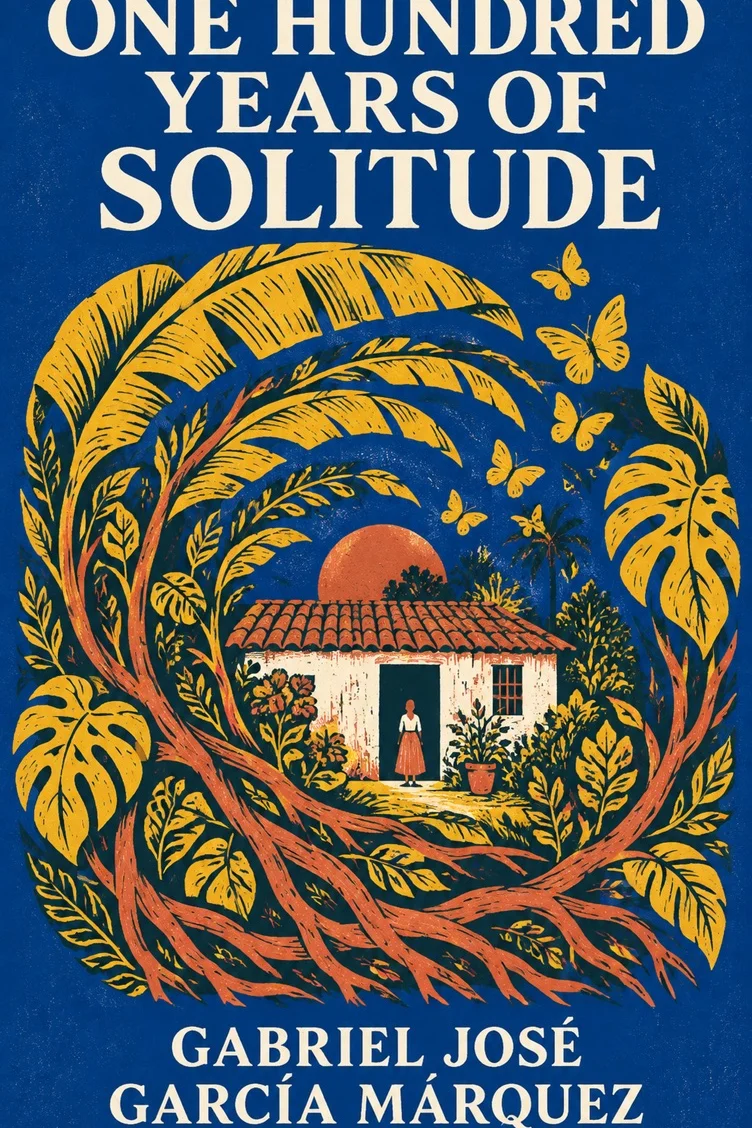
One Hundred Years of Solitude
A family founds a town in the jungle, and a century later its names, mistakes and loneliness are still repeating
Chapter IAbout the book
- First published
- 1967
- Main genre
- Magical realism
A family founds a town, and over a century its members repeat each other's names, mistakes and solitudes. One Hundred Years of Solitude opens with Colonel Aureliano Buendía facing a firing squad and remembering the afternoon his father took him to discover ice. That father, José Arcadio Buendía, and his wife Úrsula, who are cousins, found the town of Macondo after José Arcadio kills Prudencio Aguilar. Cut off from the world, the three hundred inhabitants meet the outside only when the gypsy Melquíades arrives with his latest inventions, and José Arcadio is swept up in each new marvel. The book follows the Buendía family generation after generation, and the repeating first names, José Arcadio and Aureliano, are part of the design: they make the reader feel how the family circles back on itself. García Márquez tells it in a calm, matter-of-fact voice, as if wonders were no different from the weather, in the style often called magical realism, which combines realistic portrayals of political and social conflict with mystical or supernatural events. Wars, a banana company and long spells of rain pass through Macondo, and the book treats each with the same level tone.
Chapter IIThe author and the making
García Márquez settled in Mexico City in 1961. The book came after a sudden insight while he was driving his family through Mexico: he turned the car around and drove home. He wrote for about eighteen months in a back room while his wife, Mercedes Barcha, sold, mortgaged and stretched credit to keep the family going. The Ransom Center dates the writing more narrowly, to about 13 months from July 1965 to August 1966. By one account he wrote from nine to three each day and smoked about 30,000 cigarettes, and he had planned to call the novel The House. The manuscript ran to about 1,300 pages. In August 1966 he mailed it from Mexico to Sudamericana in Buenos Aires; the couple could not afford the full postage, so the parcel was split and sent in two parts. Before this, he had never sold more than seven hundred copies of a book. After the first copy arrived he reportedly burned his manuscripts, notes and diagrams, keeping only the final typescript, now at the Ransom Center, which has over 200 handwritten corrections. Sudamericana published the novel on May 30, 1967, and copies reached the streets of Buenos Aires on June 5. A cover commissioned from Vicente Rojo did not arrive in time, so an anonymous design was used. Gregory Rabassa's English translation, for Harper and Row, appeared in 1970.
Chapter IIIHow it was received
The first edition sold fast. Eight thousand copies sold in the first week in Buenos Aires alone, and the first printings sold out before they could be shelved. The Latin American response was immediate: Pablo Neruda called it “the greatest revelation in the Spanish language since the Don Quixote of Cervantes,” Jorge Luis Borges called it profound as the cosmos and open to endless interpretations, and Mario Vargas Llosa a literary feat. Robert Kiely, reviewing the English edition in The New York Times, called it an astonishing novel. García Márquez received the 1982 Nobel Prize in Literature, and the citation highlighted this book. It has sold more than 45 million copies in 44 languages, according to the Ransom Center, which makes it the second most translated literary work in Spanish after Don Quixote. Other accounts give different totals. There were dissenters. D. J. Enright, writing in The Listener, found the depiction of civil war upsetting, wrote that these are no happy giants or jolly grotesques and that the book is hardly comic, and called it a slightly bloated avatar of Borges. For the 2007 Royal Spanish Academy edition García Márquez made 61 changes, mostly spelling corrections.
Chapter IVWhy it matters
One Hundred Years of Solitude matters because it helped establish magical realism as a major tradition of Latin American fiction, and because it turned one family's story into an account of a continent's history and its habits of repetition. Its first-week sales and its place in Spanish-language reading made it a book that readers carried across languages. For literature, it showed that a plain, level narrative voice could hold the marvellous and the political together, and it still reads, half a century on, as a profound account of Latin American history and human experience. A reader should expect to work at it. The repeated names make the family tree hard to hold in the head, the book rarely slows to explain itself, and its mood is one of fate and decline. Enright's complaint that it is hardly comic is a fair warning for readers who expect charm. The pace is steady rather than driven, and the violence of the civil wars is not softened. It suits readers who enjoy a long, rich saga and an unusual narrator, and it is a poor fit for those who want a fast plot with a hero at its centre. Rabassa's English translation is the standard one for English readers.
Chapter VIf you liked this
- Love in the Time of Cholera Gabriel García MárquezHis later novel of a slow, patient love told in the same level, lyrical voice
- The House of the Spirits Isabel AllendeA family saga across generations that mixes the marvellous with political history
- The Master and Margarita Mikhail BulgakovA novel in which the fantastic enters a political world without comment
- Midnight's Children Salman RushdieA national history told through one family and a flood of magical detail
- Magical realism
- Literary fiction
- Historical fiction
- Social commentary
Buying links are coming soon.