
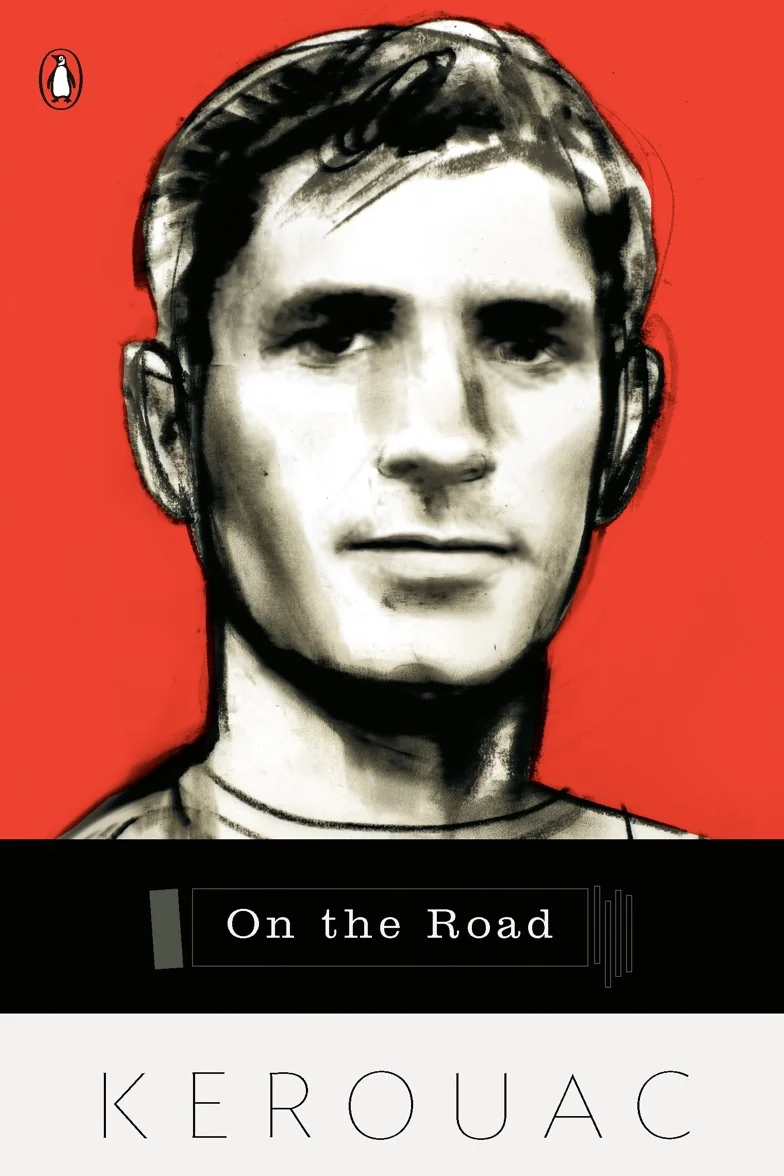
On the Road
Sal Paradise and Dean Moriarty cross America again and again, chasing a feeling they call “It”
Chapter IAbout the book
- First published
- 1957
- Main genre
- Literary fiction
Sal Paradise, a young writer based on Kerouac himself, travels back and forth across America in the company of Dean Moriarty, a charismatic friend based on Neal Cassady. On the Road is autobiographical, drawn from cross-country trips Kerouac made between 1947 and 1950. Kerouac disliked driving after a childhood car accident, so Cassady usually drove. Robert McCrum, writing in the Guardian, reads the novel as a portrait of 1950s America seen through jazz, sex, drugs and restlessness, and as a version of the American romance, linked to Huck Finn's wish to light out for the territory. Its central idea is “It”, an ecstatic moment that Sal chases but never reaches, so the trip matters more than the destination. Early drafts gave the protagonist other names, first Ray Smith and then Smitty, and Kerouac said early publishers did not allow him to reuse character names across his books. The book became a defining work of the Beat Generation, a group of young people disillusioned by militarism, materialism and conformity.
Chapter IIThe author and the making
Kerouac was a Columbia University dropout, and the legend of the book is that he wrote it in a single burst. In April 1951 he typed more than 120,000 words in 20 days onto a scroll of taped-together tracing paper, a roll about 120 feet long, because swapping in regular sheets broke his rhythm. The legend stresses spontaneity, but Kerouac had prepared extensively, keeping journals and buying roadmaps, and he wrote about the idea as early as August 1948. In December 1950 he received a letter of about 13,000 words and 40 pages from Neal Cassady, which inspired his “spontaneous prose” style. The scroll was not the final version. Revisions and many rejections followed, and one rejection sent to his agent Sterling Lord called the book “not a well made novel, nor a saleable one”. Malcolm Cowley at Viking preferred the roll typescript, and lawyers asked for real names such as Allen Ginsberg and Neal Cassady to be changed over libel concerns. Viking published On the Road in September 1957. In 2007 Penguin Classics reissued the scroll version with the characters' real names restored, and the scroll itself sold for $2.4 million in 2001.
Chapter IIIHow it was received
On September 5, 1957, Gilbert Millstein reviewed On the Road in the New York Times and gave it a rave notice. He described Kerouac as a 35-year-old Columbia University dropout, praised the book as most beautifully executed, and predicted that it would become the testament of the Beat Generation, comparing it to The Sun Also Rises and the Lost Generation. His prediction came true: Kerouac's girlfriend said he woke up famous, and the novel quickly became a bestseller. Robert McCrum later called it an “ur-text for the James Dean decade” and saw Kerouac as a prophet of 1960s counterculture, although Kerouac saw himself as reclaiming American frontier individualism. The book has not been without objections. The rejection that called it not a well made novel, nor a saleable one, was one early verdict, and Kerouac himself was dismayed by some of Cowley's editorial changes and dissatisfied with earlier drafts. Of his more than 25 books, On the Road remains his most noteworthy success.
Chapter IVWhy it matters
On the Road matters as the book that gave the Beat Generation its public voice and a template for the American road narrative. Millstein's comparison with The Sun Also Rises and the Lost Generation shows how quickly it was read as the testament of its own age, and McCrum's phrase, an ur-text for the James Dean decade, shows how far it has outlived that moment. It is also a record of a writing method. The scroll, the spontaneous prose and the years of revision that followed show that the book is less improvised than its legend, and the 2007 scroll edition lets readers see an earlier version. The honest reservation is that it is built on momentum rather than structure. A rejection that called it not a well made novel, nor a saleable one, points at what some readers still feel: the episodes accumulate more than they develop, and the pull of the trip matters more than the plot. It suits readers who enjoy restless, lyrical prose and a sense of place, and it is a poor fit for those who want a tight plot or fully drawn characters.
Chapter VIf you liked this
- The Dharma Bums Jack KerouacKerouac's follow-up, shifting the Beat search to mountains and Buddhism
- The Sun Also Rises Ernest HemingwayThe Lost Generation novel that Millstein set beside On the Road
- Travels with Charley John SteinbeckA calmer American road journey by an older writer
- Fear and Loathing in Las Vegas Hunter S. ThompsonA wilder, funnier road book in the line Kerouac started
- Literary fiction
- Adventure
- Social commentary
Buying links are coming soon.