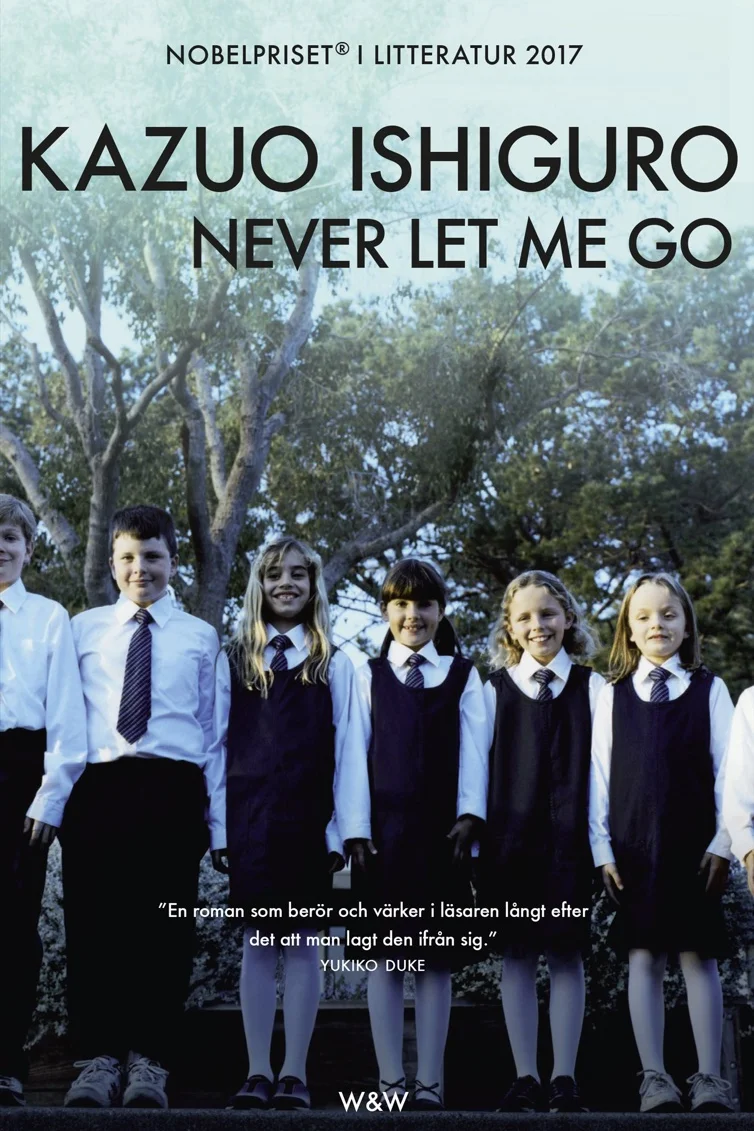
Never Let Me Go
A carer looks back on a boarding school childhood, and gradually the reader sees what the school was for
Chapter IAbout the book
- First published
- 2005
- Main genre
- Literary fiction
Kathy H. is nearing the end of her working life as a carer, and she looks back on Hailsham, a boarding school that seemed like a pleasant English country house. Never Let Me Go is told in her calm, retrospective voice, and the horror lies in what the narrator does not find horrifying. Kathy is 31 and has looked after donors for 11 years, far longer than is typical. She remembers Hailsham as an elite boarding school in an old country house, where her friends include Ruth, a bossy girl, and Tommy, an isolated boy with poor artistic skills. As the students grow older, Tommy and Ruth start dating, and Kathy has been told that her caring role will end soon. The words carer and donor carry weight from the start, and the book lets the reader work out what they mean before the characters say it aloud. Ishiguro sets it in an alternative England of the 1990s, in which genetic engineering rather than nuclear technology shaped the twentieth century. Its central question, in the author's words, is what really matters if you know that this is going to happen to you.
Chapter IIThe author and the making
Kazuo Ishiguro was born in Nagasaki in 1954, moved to England at the age of five and later studied at the University of East Anglia. His 1989 novel The Remains of the Day won the Booker Prize, and he won the Nobel Prize in Literature in 2017. Never Let Me Go was his sixth novel. He had been writing fragments about a group of young students for years, beginning in the 1990s, and the framework only fell into place after a radio discussion of biotechnology in 2001. The first version had included a nuclear bomb plot. He has said he wanted a story that was simple but very fundamental, about the sadness of the human condition, and he did not want a future setting because he did not want anything that could be mistaken for a prophecy. He has described the book as an alternative history rather than a pure dystopia, and he saw the narrator's memories as a source of consolation. For the structure he said he concertinaed the time span through the device of Kathy's retelling. The title comes from a jazz standard that Nat King Cole performed in the 1956 film The Scarlet Hour, as Ishiguro found it on the sleeve of Bill Evans's album Alone. Faber and Faber published the novel in 2005.
Chapter IIIHow it was received
Never Let Me Go was shortlisted for the Booker Prize in 2005, was a finalist for the National Book Critics Circle Award, and was named TIME's best novel of the year. In 2006 it was shortlisted for the Arthur C. Clarke Award and won an ALA Alex Award. The Guardian ranked it fourth on its 2019 list of the 100 best books of the 21st century, and The New York Times placed it ninth on its 2024 list. Reviews at the time were mixed. Louis Menand, in The New Yorker, called it quasi-science-fiction and noted many plot holes, and Sarah Kerr in The New York Times described the set-up as potentially dime-store-novel while praising its handling of memory and friendship. Joseph O'Neill in The Atlantic found it a successful coming-of-age story. The horror author Ramsey Campbell called it a classic instance of a story that is horrifying precisely because the narrator does not think it is. The 2010 film, directed by Mark Romanek, starred Carey Mulligan, Andrew Garfield and Keira Knightley, and a Japanese television drama set in Japan aired in 2016 on the Tokyo Broadcasting System.
Chapter IVWhy it matters
Never Let Me Go matters as the book in which a restrained literary novelist borrowed the machinery of science fiction without the usual explanations. It asks what a life means when its length is known, and it does so through friendship, jealousy and memory rather than spectacle. Ishiguro said he wanted readers to find an echo of their own lives in the story, and the quiet pace is how it achieves that. The Nobel Prize in 2017 turned attention to the whole body of his work, and this novel has become one of the books readers start with. It is a good fit for those who like understatement and reading between the lines. Be ready for its limits. Critics have complained of plot holes and of a set-up that sits uneasily between literary fiction and science fiction, and the narrator never questions her situation as a reader might. There is little action and no escape plot. It is a poor fit for readers who want the world explained, or who need a hero to rebel. It suits patient readers who can take sadness without a consoling resolution. Start with the first chapters; the tone does not change.
Chapter VIf you liked this
- The Remains of the Day Kazuo IshiguroHis Booker-winning novel, another unreliable first-person look back on a sheltered life
- Brave New World Aldous HuxleyA classic of engineered lives, in a far more satirical key
- The Handmaid's Tale Margaret AtwoodA narrator describing a controlled life in a calm, retrospective voice
- Klara and the Sun Kazuo IshiguroHis later novel about a narrator who observes human lives from the outside
- Literary fiction
- Science fiction
- Dystopian fiction
Buying links are coming soon.