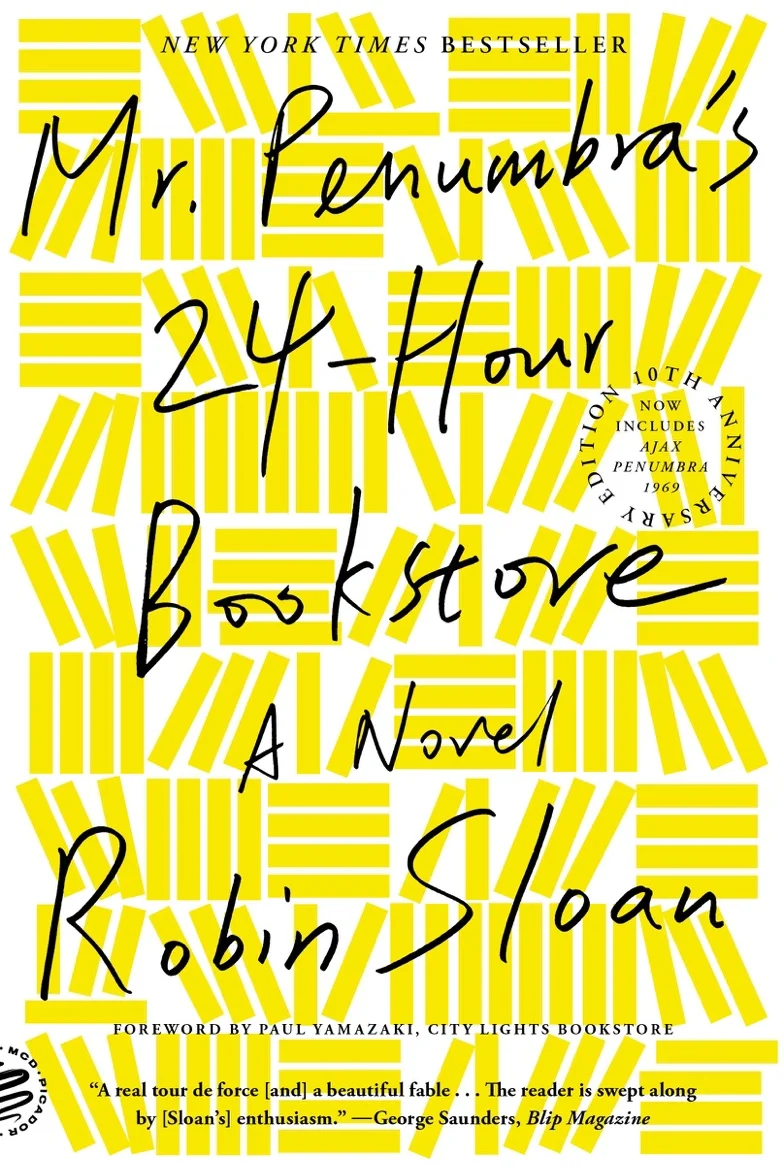
Mr. Penumbra's 24-Hour Bookstore
A laid-off software developer takes a night job at a San Francisco bookshop and stumbles onto a 500-year-old secret society
Chapter IAbout the book
- First published
- 2012
- Main genre
- Mystery
- Length
- 288 pages
Clay Jannon, a laid-off software developer, takes a night job at a dusty San Francisco bookstore that never seems to close. The novel turns from a job-hunting comedy into a mystery with a 500-year-old secret society at its centre. Clay lost his job at a startup, and the shop he joins has few customers but plenty of secrets: its unusual books lead him towards a puzzle that the society, which calls itself the Unbroken Spine, has pursued for centuries. The book mixes fantasy, mystery and adventure, and it sets printed books against new technology, a tension that Clay, a web designer who understands code and data, is well placed to test. Its San Francisco is mostly a realistic present-day city in which a little fantasy goes a long way, and the hardcover runs to 288 pages. It began as a short story and became Sloan's first novel. A prequel novelette, Ajax Penumbra 1969, was published in 2012.
Chapter IIThe author and the making
Robin Sloan grew up in Troy, Michigan, and graduated from Michigan State University in 2002 with a degree in economics. In 2003 he co-founded the blog SnarkMarket, and in 2004 he moved to the San Francisco Bay Area to work at Current TV as a media strategist and interactive producer. The book began with a tweet from his friend Rachel Leow on November 15, 2008, saying she had just misread “24hr bookdrop” as “24hr bookshop”. Walking down California Street in San Francisco, Sloan imagined what a 24-hour bookstore would look like and wrote the image down, and soon after the New Year he started writing. The first draft already had a proprietor named Penumbra. He first wrote it as a short story of about 6,000 words and published it himself on his website and the Kindle Store: “I was a blogger, so it felt natural to publish the story myself.” Readers responded warmly, and months of continued interest convinced him that “there was a much larger story lurking there”. The novel was published in 2012 by Farrar, Straus and Giroux, in a hardcover whose cover, designed by Rodrigo Corral, glows in the dark. Of the book finding him, Sloan said: “I feel lucky that it got to be me.”
Chapter IIIHow it was received
Reviews were largely warm. Roxane Gay in the New York Times Sunday Book Review said the novel “dexterously tackles the intersection between old technologies and new”, and Jesse Singal in the Boston Globe recommended it to anyone who had wondered about “the epochal changes wrought by the digital revolution”. Pradeep Sebastian in The Hindu called it “a biblio-thriller for the typophile lurking inside all of us”, and Kate Ayers of Bookreporter said it was the most fun she had had with a book since the first Harry Potter. NPR titled its review “Page And Screen Make Peace In ‘Mr. Penumbra’”. There was dissent: Farhad Manjoo in Slate called it a fantasy mostly set in a realistic present-day San Francisco and faulted it for skirting how digitising art changes it. The San Francisco Chronicle listed the novel among its top 100 books of 2012, the New York Times named it an Editor's Choice, and it appeared on the New York Times hardcover fiction bestseller list. BookPage chose its cover as one of the 25 best book covers of 2012, and Janet Maslin reviewed the novel for the New York Times on November 7, 2012.
Chapter IVWhy it matters
Mr. Penumbra's 24-Hour Bookstore arrived in 2012, when the argument over e-books and printed books was loud, and it treats that argument as an adventure rather than a lecture: a web designer who understands data and a shelf of old books that hold a secret end up on the same side. Roxane Gay's phrase, the intersection between old technologies and new, describes its appeal well. It is also an early example of a novel that grew out of online writing, since it began as a short story on a website and the Kindle Store before Farrar, Straus and Giroux published it. The reviewer Jaya Bhattacharji Rose calls it a book that lingers, writing: “A book that lingers with you for a long time afterwards is a treasure”. The honest reservation is that its treatment of technology is light. Manjoo's complaint in Slate, that it skirts how digitising art changes it, is a fair one, and most other reviews quoted here are enthusiastic recommendations rather than critical assessments. It suits readers who like a bookish mystery with a little fantasy and some Silicon Valley detail, and it is a poor fit for readers who want a rigorous study of publishing or technology, or a deep character study.
Chapter VIf you liked this
- The Shadow of the Wind Carlos Ruiz ZafónA bookish mystery built around a hidden library and a lost author
- Ready Player One Ernest ClineA puzzle-driven adventure that mixes technology with love of old culture
- The Eyre Affair Jasper FfordeA comic fantasy in which literature itself is the setting
- Sourdough Robin SloanSloan's second novel, another warm, odd story about work and technology
- Mystery
- Fantasy
- Adventure
Buying links are coming soon.