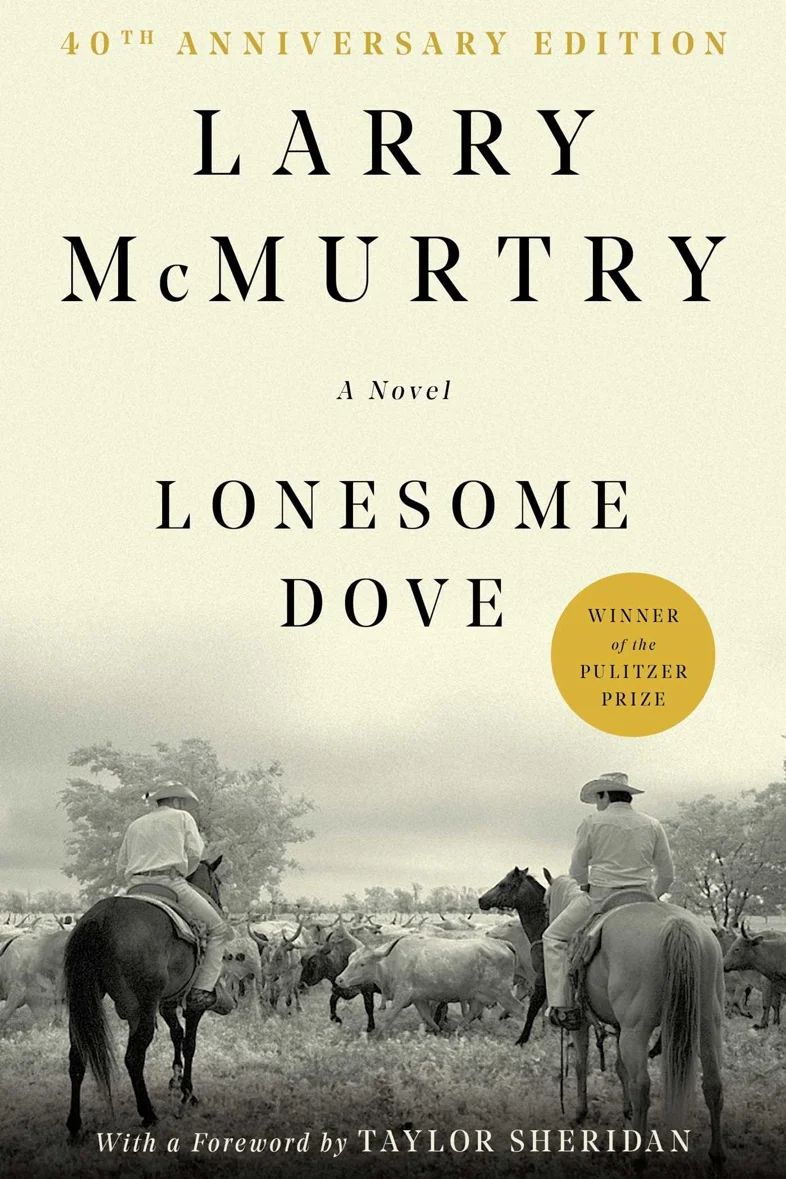
Lonesome Dove
Two retired Rangers and a herd of stolen cattle head for Montana, in a Western that is wary of its own legend
Chapter IAbout the book
- First published
- 1985
- Main genre
- Historical fiction
Two retired Texas Rangers who have run out of reasons to stay decide to drive a herd of cattle north to Montana, a country none of them has seen. Lonesome Dove opens in a dusty border town on the Rio Grande, where Augustus McCrae and Woodrow Call run the Hat Creek Cattle Company. Gus is talkative, fond of whiskey and of his old love Clara; Call is silent, driven and restless, and he is the one who first proposes the drive north. The plan takes shape after Jake Spoon, a charming outlaw, arrives in town after a killing in Fort Smith and describes Montana as a cattleman's paradise. Around them is a wide cast: Lorena Wood, a prostitute who leaves town with Jake, and Xavier Wanz, the saloon keeper who loves her; the younger hands Newt, Pea Eye and Deets and the cook Bolivar; and July Johnson, a sheriff, and his restless wife Elmira. Somewhere out on the trail waits Blue Duck, a Comanchero. McMurtry sets the story in the late nineteenth century and treats it as a story of three longtime friends drawn into an adventure, not as a legend of the West.
Chapter IIThe author and the making
Lonesome Dove was McMurtry's tenth novel, and most of his earlier books were set in the contemporary West. It began as a different project. McMurtry first planned a western screenplay, Streets of Laredo, that would have starred John Wayne, and when that fell through he turned the idea into a novel. He drew on real history: Charles Goodnight's cattle drives of 1860 and Nelson Story's 1866 drive to Montana. The novel appeared in 1985 and won the 1986 Pulitzer Prize for Fiction. McMurtry later said he did not set out to write a book that glorified the myth of the West, and also did not set out to debunk it, though he thought it was in a way a critique of that myth, and he pointed to Clara Allen's rebuke of Captain Call as an example. Asked about readers who took it as a straight Western, he answered with a question: would you like your menfolk to be that way? His other books included The Last Picture Show, adapted as a 1971 film directed by Peter Bogdanovich, Horseman, Pass By, which became the film Hud, and Terms of Endearment. McMurtry later wrote three more novels about the same people: Streets of Laredo in 1993, Dead Man's Walk in 1995 and Comanche Moon in 1997. He died on March 25, at the age of 84.
Chapter IIIHow it was received
The book was praised for its warmth and its feel for the work of the trail. Nicholas Lemann wrote that everything about the book feels true, and Walter Clemons said the whole book moves with joyous energy. Christopher Lehmann-Haupt observed that much of the story recalls earlier Westerns, but credited McMurtry with bending those clichés in interesting ways. There were reservations. Whitney Balliett said the novel never quite gets free of the glutinous pace of its opening pages, and he wanted a map, since McMurtry is vague about place. The 1986 Pulitzer Prize for Fiction came the year after publication. A 1989 miniseries with Robert Duvall as Gus and Tommy Lee Jones as Call became a huge hit and brought the book to a far wider audience, and it was followed by Return to Lonesome Dove, a 1993 miniseries set a year after the novel's events, in which McMurtry was not involved. Scholars have read the novel as a deliberate disruption of the Western's single story. John Miller-Purrenhage argues that it uses the conventions of the genre to challenge who counts as we, and that its broken groups and families work as a critique of any single national story.
Chapter IVWhy it matters
Lonesome Dove matters because it took the cattle drive, the central set piece of the Western, and treated it without glory. McMurtry said the Western myth is a heroic myth, and yet settling the West was not heroic. The book's epigraph from T. K. Whipple points the same way, and critics note that McMurtry avoids glorifying the West and presents its people as flawed but vivid. It shows that a genre story can carry a long, humane novel about friendship, loss and stubbornness. A reader should expect a slow start. Balliett's complaint about the opening pages is one that others share, and the book is long, with a large cast and little hurry. McMurtry is also vague about geography, so a map helps. It suits readers who like character and talk more than action, and it is a poor fit for those who want a fast, heroic Western. The sequels and prequels were written later, so the novel can be read first. The prequels Dead Man's Walk and Comanche Moon go back to the 1840s and the 1850s and 1860s, and Return to Lonesome Dove, the miniseries, was made without McMurtry. Start with the novel itself.
Chapter VIf you liked this
- Blood Meridian Cormac McCarthyAnother Western that refuses to glorify the frontier, in a far harsher key
- Shane Jack SchaeferA short classic Western of the kind Lonesome Dove quietly argues with
- True Grit Charles PortisA Western with a strong voice, dry humour and an unlikely band on the trail
- The Sisters Brothers Patrick deWittA darkly funny Western about two men on a long road
- Historical fiction
- Adventure
- Literary fiction
Buying links are coming soon.