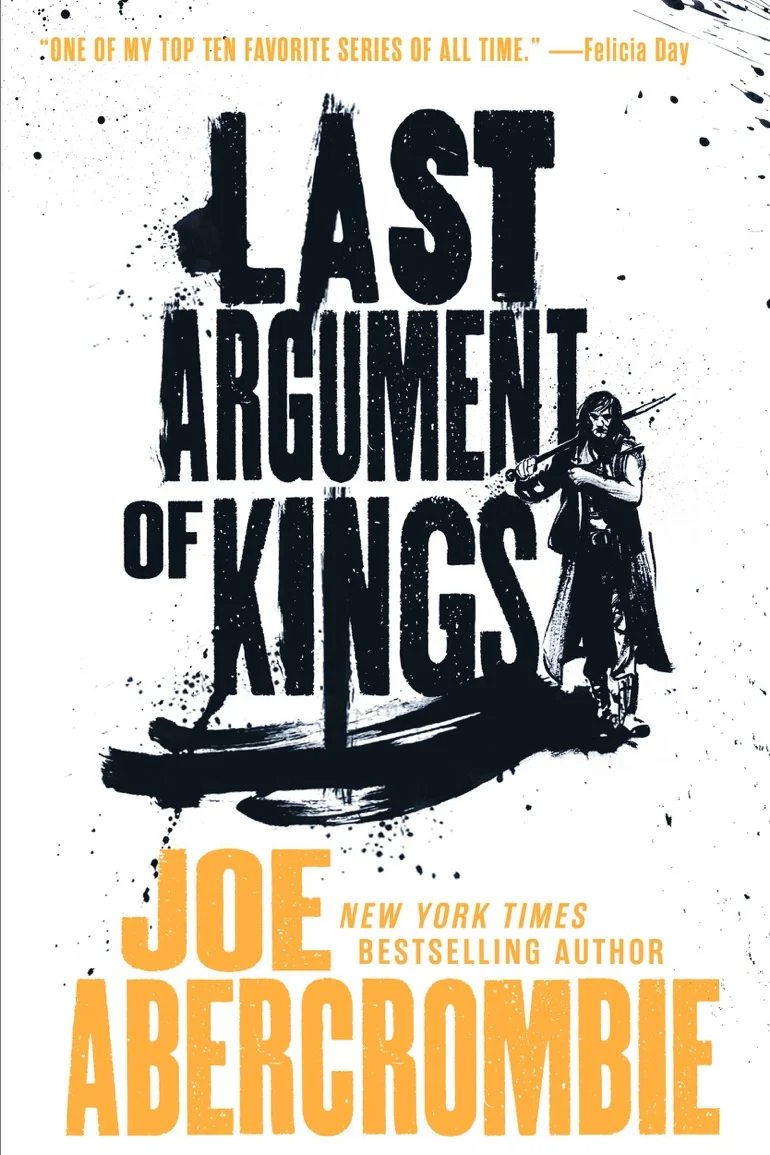
Last Argument of Kings
The trilogy where the heroes are torturers, barbarians and cowards ends with its war and its bills
Chapter IAbout the book
- First published
- 2008
- Main genre
- Fantasy
- Length
- 603 pages
Three damaged men, a torturer, a barbarian and a vain young swordsman, are caught up in a war that an ancient wizard is steering. Last Argument of Kings is the third and last book of The First Law, after The Blade Itself and Before They Are Hanged, so the people and the war are already in motion. Sand dan Glokta is a former swordsman crippled by years of Gurkish torture who now serves the Union's Inquisition as a torturer. Logen Ninefingers is a feared Northern warrior who wants to step away from the violence he has lived by. Jezal dan Luthar is a vain, immature nobleman who trained for a major tournament. Bayaz, First of the Magi, is an ancient wizard whose political skill matches his magic. Around them are the Union, a powerful kingdom resembling Western and Central Europe, and the North, whose Northmen have invaded the Union's province of Angland. The title refers to Louis XIV's phrase for the cannon, and it hints at a book in which a final reckoning is reached by force, not by prophecy.
Chapter IIThe author and the making
Joe Abercrombie began the First Law trilogy in 2002 and was, by his own account, trying to write the kind of books he would like to read. The series was in part a reaction to things he disliked in the epic fantasy he read as a kid. He names George R. R. Martin as the writer who made him realise that fantasy could be ruthless, surprising and morally ambiguous, and David Eddings as the template for eighties fantasy that he has tried to twist and corrupt. He has said he had the ending more or less in mind from the start, and that he drew a few childish scratchings as source material. The titles carry their own sources: The Blade Itself comes from a line in Homer's Odyssey, Before They Are Hanged from Heinrich Heine, and Last Argument of Kings from the Latin phrase Louis XIV had inscribed on his cannons, Ultima Ratio Regum. Gollancz published The Blade Itself on 4 May 2006, Before They Are Hanged on 15 March 2007 and Last Argument of Kings on 20 March 2008, a book of 603 pages and about 234,100 words. Of the characters, Abercrombie said that after five years it felt as if he had been stuck in a lift with them.
Chapter IIIHow it was received
A reviewer in 2008 called Last Argument of Kings without a doubt the strongest novel in the cycle, praised its fight scenes as comparable to the best of the best from the UFC, and said its characters are people, plain and true people, as flawed and real as you or I. Sand dan Glokta, he said, steals the show, and the book fixes the pacing problems of the earlier volumes. Publishers Weekly said readers will mourn the end of this vivid story arc, and SFX's David Bradley gave it five stars. The same review was candid about the trilogy's weaknesses. It found the first two books lethargic in pacing, called Jezal dan Luthar such an unlikable bastard in the earlier novels, though more likable here, and ended with the jab that the trilogy still has no map. In the series generally, Strange Horizons advised that readers must accept morally ambiguous heroes, and Jon Courtenay Grimwood wrote in The Guardian that The Blade Itself comes close to living up to its publisher's hype. Abercrombie's short story Tough Times All Over won a Locus Award.
Chapter IVWhy it matters
Last Argument of Kings matters as the ending of a trilogy that showed epic fantasy could keep its swords and armies while dropping the comfort of heroes. Abercrombie wanted a story that was ruthless, surprising and morally ambiguous, and the third book is where that bargain comes due. For fantasy readers raised on Eddings-style quests it is a deliberate counter-argument, and the book rewards close readers because its titles and structure are built from older sources. It is not a place to start. It is the third of three, and it relies on what has gone before, so begin with The Blade Itself. Be ready for what the trilogy asks. Some readers find the first two books slow, one reviewer found Jezal such an unlikable bastard, and the books are violent, including scenes of torture. It suits readers who like dark humour, morally grey characters and a story that ends the way it begins, and it is a poor fit for those who want heroes who stay heroic. Abercrombie says he has been mildly annoyed by depictions of torture in books and on television, which is a clue to how he writes it. Later books set in the same world exist, but this one closes the first story.
Chapter VIf you liked this
- A Game of Thrones George R. R. MartinAbercrombie's own named influence, a fantasy that is ruthless, surprising and morally ambiguous
- The Blade Itself Joe AbercrombieThe first book of The First Law, and the place to start the trilogy
- The Lies of Locke Lamora Scott LynchA darkly funny fantasy with flawed, clever people and a violent world
- Prince of Thorns Mark LawrenceAnother dark fantasy with a morally compromised protagonist
- Fantasy
- Epic
- War fiction
Buying links are coming soon.