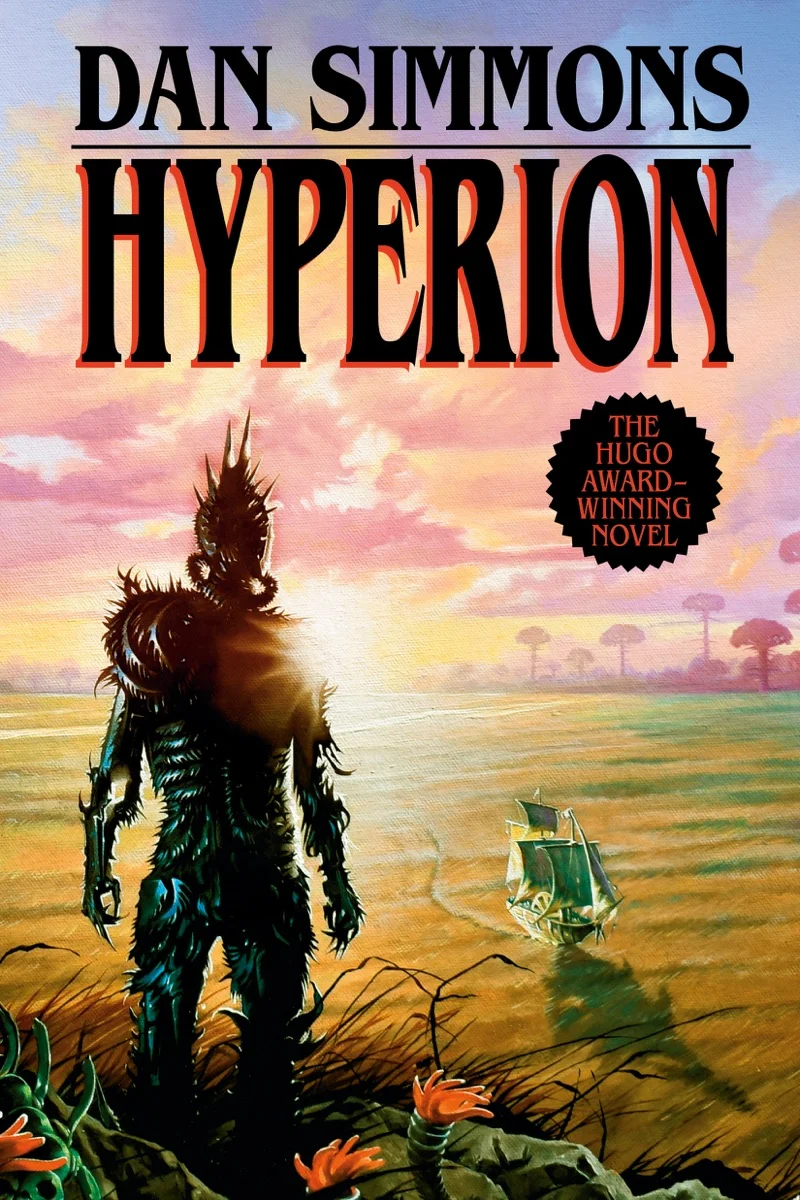
Hyperion
Seven pilgrims travel to a tomb that moves backward in time, and each tells the tale that brought them there
Chapter IAbout the book
- First published
- 1989
- Main genre
- Science fiction
Seven pilgrims set out for a world where a tomb that runs backward in time is guarded by a legendary killer, and each has a story to tell on the way. Hyperion opens around 2732, on the eve of a war that may end the human Hegemony. The Hegemony links hundreds of planets through farcaster portals and keeps an uneasy alliance with the TechnoCore, a civilization of artificial intelligences, while the Ousters, modified humans living in space stations, press in from outside. Hyperion itself is an Outback world with no farcasters. Its Time Tombs are guarded by the Shrike, a creature of legend, and a pilgrimage to the Tombs is the one road that might ask something of it. The Shrike grants one wish to each pilgrim. The group is a priest, a soldier, a poet, a scholar, a detective, a consul and a ship's captain, and the book follows the Canterbury Tales design: a frame story of travellers who pass the journey telling their stories, each in a different genre and voice. Between the tales the pilgrims bicker and the Ouster invasion draws closer.
Chapter IIThe author and the making
Dan Simmons was born on April 4, 1948, in Peoria, Illinois, earned a B.A. in English from Wabash College in 1970 and took a Masters in Education at Washington University in St. Louis in 1971. He worked in elementary education until 1989, the year Hyperion was published, and the Hyperion universe began as an extended tale told to his elementary school students. The Shrike first took shape in 1971, in an epic poem he was writing for fun, and his short story “Remembering Siri” (1983) became the nucleus of the novels. He had already published Song of Kali in 1985, which won the 1986 World Fantasy Award, and Carrion Comfort followed in 1989. Hyperion was his first foray into long-form science fiction. Money drove the pace: he wrote the first two volumes in 18 months because he and his wife wanted to buy an old house. He has described the structure as Chaucer-esque, said he borrowed central themes and titles from John Keats, and said Brawne Lamia's tale was his first celebration of a Chandleresque, Hammettesque tone. He also moved from cyberpunk to Jack Vancian space opera. Doubleday published the book in 1989. For reasons of length it appeared separately from the sequel, The Fall of Hyperion, and Simmons waited four years before writing the closing volumes. He died in Longmont, Colorado, on February 21, 2026, at the age of 77.
Chapter IIIHow it was received
Hyperion won both the Hugo and Locus Awards in 1990, was nominated for the 1991 BSFA Award for Best Novel, and, together with its sequel, was nominated for the 1992 Arthur C. Clarke Award. The New York Times praised its literary references, its format and its treatment of the Ultimate Intelligences, and other readers call it a cult classic, singling out the worldbuilding and the characters. Not everyone was equally taken. Critics have noted that much of the story takes place in flashbacks, which leaves limited room for the plot to advance, and the book stops before the pilgrims reach the Tombs. A small mark of its reach: the novel turns up in several episodes of the anime The Melancholy of Haruhi Suzumiya, where a character is given a Japanese translation of it. Its path to the screen has been long. Scott Derrickson was set to direct a film for Warner Bros. and Graham King in 2009, with a script by Trevor Sands that combined Hyperion with The Fall of Hyperion. Bradley Cooper expressed interest in taking over the project in 2011, Syfy announced a miniseries in June 2015, and in November 2021 Warner Bros. and Cooper began developing a Hyperion film instead.
Chapter IVWhy it matters
Hyperion matters for how it borrows. Its frame comes from Chaucer and Boccaccio's Decameron, and its title and recurring quotations come from Keats's unfinished epic, so a space opera is also a conversation with the poets. Each pilgrim's tale uses a different literary mode, and Simmons said Brawne Lamia's tale, the detective's, was his first celebration of a Chandleresque, Hammettesque tone. It is a good argument that a novel can be a collection of short stories without losing momentum. For a reader the cost is clear. The book does not end the journey: it was published separately from The Fall of Hyperion for reasons of length, and you will want the second volume at hand before you start. The flashback form means the present-tense plot moves slowly, and several readers find some tales stronger than others. It suits readers who like Canterbury-style anthologies, literary allusion and large ideas, and it is a poor fit for those who want a single continuous chase. Its awards and its long list of film attempts show that it has stayed in view since 1989.
Chapter VIf you liked this
- The Fall of Hyperion Dan SimmonsThe direct sequel, written to finish what Hyperion leaves open
- The Canterbury Tales Geoffrey ChaucerThe pilgrim frame story that Hyperion openly follows
- Dune Frank HerbertAnother large-scale far-future space opera with factions, religion and prophecy
- A Fire Upon the Deep Vernor VingeSpace opera of big ideas and unusual aliens from the same era
- Science fiction
- Philosophical fiction
- Adventure
Buying links are coming soon.