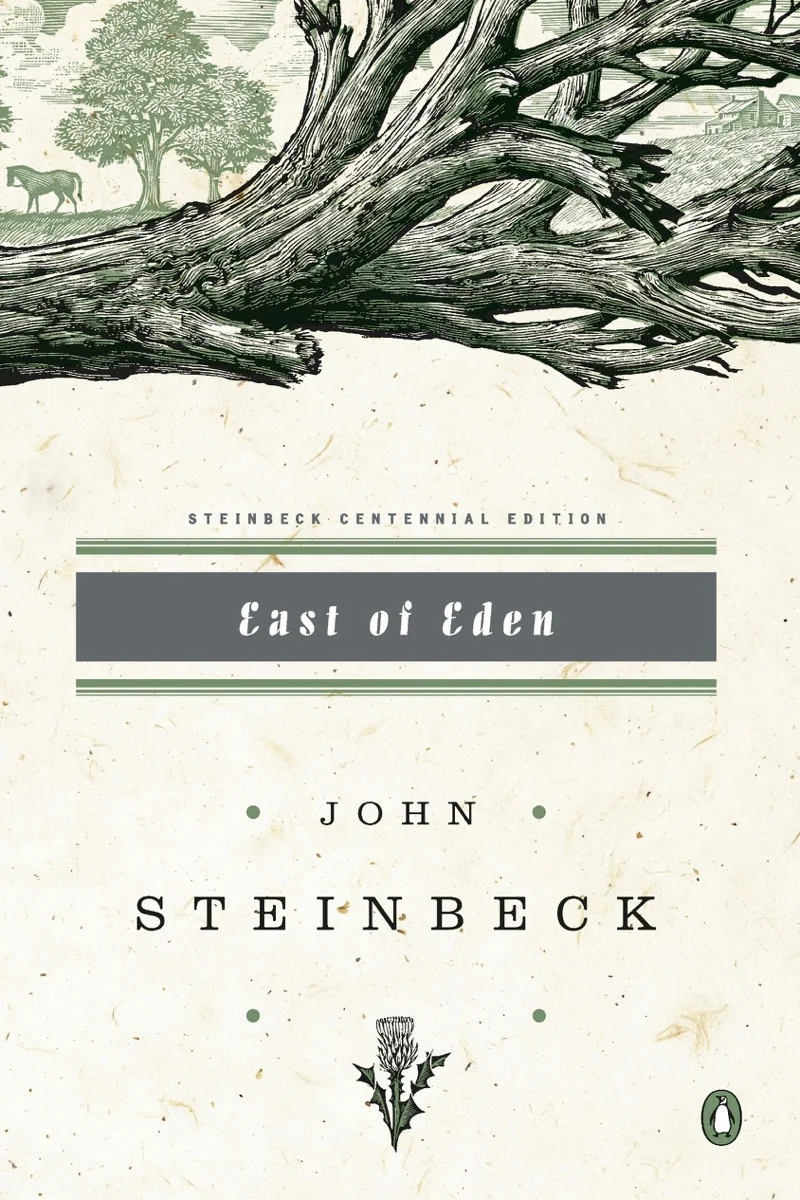
East of Eden
Two families, two pairs of brothers and one California valley: Steinbeck retells Cain and Abel across generations
Chapter IAbout the book
- First published
- 1952
- Main genre
- Literary fiction
East of Eden follows the Hamilton and Trask families through generations in California's Salinas Valley. It retells the story of Cain and Abel through two pairs of brothers, Adam and Charles Trask, then Cal and Aron. John Steinbeck was born and raised in the Salinas Valley and drew on his maternal family, the Hamiltons, who settled there; he blended that real history with fictional characters and wrote himself into the book as a first-person narrator. The novel runs to more than 600 pages and takes in love and jealousy, loyalty and betrayal, and good and evil, with a central idea that its characters call timshel. Its cast includes Cathy, whom the New York Times called “The most vicious female in literature”, and Lee, the philosophising Chinese houseboy. Parts of the book follow the Hamiltons and parts follow the Trasks, and the narrator moves between them. Steinbeck regarded it as his major work and said he wrote it for his two young sons.
Chapter IIThe author and the making
John Steinbeck was 50 when East of Eden came out in 1952, and he regarded it as his major work. He said: “I think everything else I have written has been, in a sense, practice for this.” He had felt his reputation slipping after Tortilla Flat in 1935 and The Grapes of Wrath in 1939, and he later spoke of 11 years of “mental gestation” behind the book. He wrote it for his two young sons, Thom and John, and he believed the story of Cain and Abel was the basis of all human neurosis. While drafting it he kept a daily routine: between January 29 and October 31, 1951, he wrote a warm-up letter to his friend and editor Pascal Covici on the left-hand pages of a notebook Covici had given him, then wrote the novel on the right-hand pages. The letters were not meant for publication and were later issued as Journal of a Novel: The East of Eden Letters, which records the novel's development, its plot and characters and his philosophy of writing. East of Eden was published on September 19, 1952.
Chapter IIIHow it was received
East of Eden sold strongly and reached number one on the fiction bestseller list by November 1952, and Steinbeck said he was receiving “flocks of letters” from readers. Critics were divided. Anthony West in The New Yorker called the book “puerile” and “verbal syrup”. The New York Times called it “Clumsy in structure and defaced by excessive melodramatics” yet a “serious and on the whole successful effort”. A Washington Post reviewer defended its flaws by comparison with Don Quixote and wrote that “no one can doubt its merits as the work of a great storyteller”, while Samuel F. Morse of The Hartford Courant argued that Steinbeck was more a moralist than a novelist. Critics most often attacked Cathy, the heavy-handed Biblical framework and the idea of timshel, and Louis Owens and Richard Peterson later argued that the Hamilton sections and the shifting narrator weaken the book's unity. Later readers sided with the book: according to the biographer Jackson Benson, the intrusive narrator, Cathy and Lee, whom critics disliked, were often what readers found most engaging. Oprah's Book Club chose it in 2003, and it climbed back to second place on the bestseller list. It has never been out of print and sells about 50,000 copies a year. Steinbeck won the Nobel Prize in Literature in 1962. Elia Kazan directed the 1955 film, with James Dean as Cal Trask, which earned four Oscar nominations; Jo Van Fleet won Best Supporting Actress.
Chapter IVWhy it matters
East of Eden matters because it shows how far a novel's reputation can drift from its first reviews. Critics in 1952 found it melodramatic, over-symbolic and structurally uneven, yet readers made it a bestseller and have kept it in print ever since, and it is now widely regarded as one of the great novels of the 20th century. Steinbeck himself considered it the work that everything else had been practice for, and the ambition shows: it takes on the Cain and Abel story as a question about choice, and it does so across two families and many years. Its most criticised features are also its most distinctive, because the intrusive narrator, the villainous Cathy and the philosophising Lee were what critics disliked and what many readers loved. Be ready for the weaknesses critics described. The moral argument is heavy-handed at times, the Hamilton and Trask material does not always fit together, and some readers find its picture of good and evil exaggerated. It suits readers who enjoy a long family saga with a strong moral argument and a vivid setting, and it is a poor fit for those who dislike moralising or melodrama in fiction. At more than 600 pages, it also asks for time.
Chapter VIf you liked this
- The Grapes of Wrath John SteinbeckSteinbeck's other great California novel, tighter and more political
- The Brothers Karamazov Fyodor DostoevskyA family saga of brothers, guilt and moral choice
- Giant Edna FerberA multi-generational family saga of land and power in Texas
- Lonesome Dove Larry McMurtryA long American saga with vivid characters and a strong sense of place
- Literary fiction
- Historical fiction
Buying links are coming soon.