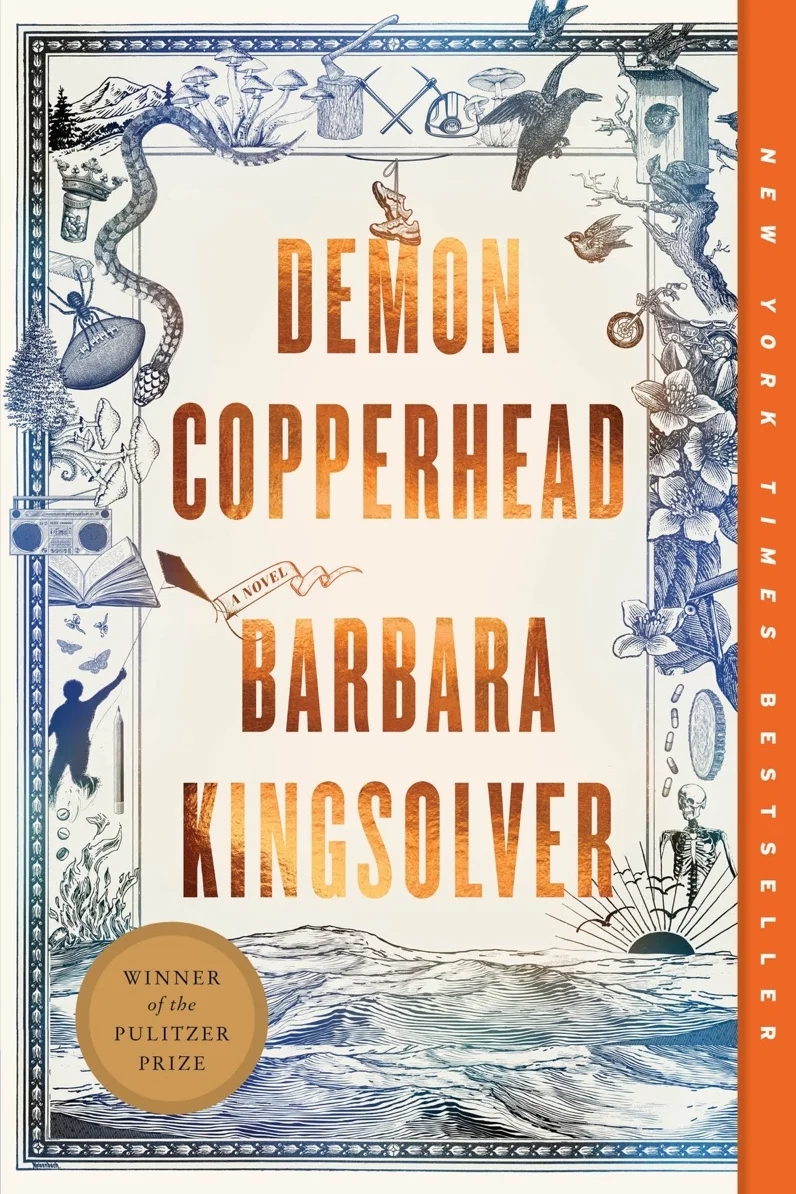
Demon Copperhead
David Copperfield retold by a red-haired boy from the Virginia hills, in the middle of the opioid crisis
Chapter IAbout the book
- First published
- 2022
- Main genre
- Literary fiction
- Length
- 560 pages
A red-haired boy is born to a teenage mother in a Virginia trailer and has to raise himself in a place that has already written him off. Demon Copperhead is narrated by the boy himself, in a voice that is funny, angry and quick, and it retells David Copperfield in present-day Appalachia. Damon Fields is born in a trailer home in Lee County, in the Appalachian Mountains of Virginia, to a single teenage mother. He gets his nickname for his red hair, which he inherits from the Melungeon father who drowned at a watering hole called the Devil's Bathtub. In early childhood he spends much of his time with the neighbours, Mr. and Mrs. Peggot, and their grandson Matt, who becomes his best friend. The book's characters echo Dickens's cast: the stepfather Stoner stands in for Murdstone, and Coach Winfield for Mr. Wickfield. But the voice is Demon's own, a cynical, wised-up teller who hides a yearning for love under a self-protective surface, and the book never explains the region to outsiders. The pressures in his life, poverty, foster care, football and the pills that circulate in every kitchen, shape the story from the first chapters.
Chapter IIThe author and the making
Barbara Kingsolver grew up in Kentucky and did not realise until college that the region was often viewed with contempt. She was surprised that her accent drew laughter, which made her see that others thought it acceptable to mock it. She has said, “I've been waiting a long time to write a novel about Appalachia.” The idea of a Dickens retelling came with a worry about how to tell a story nobody really wanted to hear: she spent several years wondering how to do it. The answer was Dickens himself, who in her words won readers over with David Copperfield and Oliver Twist, and she mapped her story onto the structure of David Copperfield. The voice came when she let the boy narrate: he started talking to her and would not shut up. At first Demon was too angry and she had to dial him back. She also spent time with people living that life. “Every single family I know has been affected by the opioid crisis,” she told The Irish Times, adding that virtually every one of those people became addicted through a doctor's prescription. Harper published the 560-page novel on October 18, 2022. Her earlier novel The Poisonwood Bible had been a 1999 Pulitzer finalist.
Chapter IIIHow it was received
Kirkus called Demon Copperhead an angry, powerful book seething with love and outrage for a community too often stereotyped or ignored, and noted that Demon's cynical, wised-up voice is light-years removed from David Copperfield's earnest tone. Ron Charles of The Washington Post named it his favourite novel of 2022. The book won the 2022 James Tait Black Prize for Fiction and the 2023 Women's Prize for Fiction, which made Kingsolver the first author to win it twice, after The Lacuna in 2010. In 2023 it also shared the Pulitzer Prize for Fiction with Hernan Diaz's Trust. The New York Times later ranked it 61st on its list of the 100 best books of the 21st century. Not every critic agreed with the praise. Lorraine Berry of The Boston Globe called it poverty porn, arguing that it makes Appalachian people objects of pity and implies that drug abuse and rejecting education are moral choices. Others, including Elizabeth Lowry in The Guardian, argued that its critique of institutional poverty and its effect on children remains relevant. Kingsolver had said that rural people are often portrayed as ignorant backwoods degenerates, the butt of every joke, and the book was written against that image.
Chapter IVWhy it matters
Demon Copperhead matters because it puts a nineteenth-century social novel to work on a present-day emergency. The opioid crisis, foster care and rural poverty are usually met in statistics or headlines, and Kingsolver makes them the daily weather of one boy's life, in a voice that is hard to put down once it starts. It is also an argument about who gets to tell Appalachia's story: she grew up in the region and wrote in defence of how it is portrayed. As a retelling it shows how a Victorian plot can still bear weight. The parallels are close enough that Dickens readers can see each turn coming, and the book gives a reader who has never opened David Copperfield no disadvantage. A reader should expect the cost. The novel is 560 pages, its subject matter is bleak, and the Boston Globe's objection, that it risks turning people into objects of pity, is a real question to bring to the book. It suits readers who enjoy a strong narrator and a social purpose, and it is a poor fit for those who want a light or hopeful read.
Chapter VIf you liked this
- David Copperfield Charles DickensThe Victorian novel that Kingsolver mapped her story onto, character for character
- The Poisonwood Bible Barbara KingsolverHer earlier novel, also told through strong first-person voices
- Hillbilly Elegy J. D. VanceA memoir of the same region and its troubles, often read next to this novel
- Where the Crawdads Sing Delia OwensA child alone in a hard rural place, told with a strong sense of landscape
- Literary fiction
- Social commentary
- Coming-of-age
Buying links are coming soon.