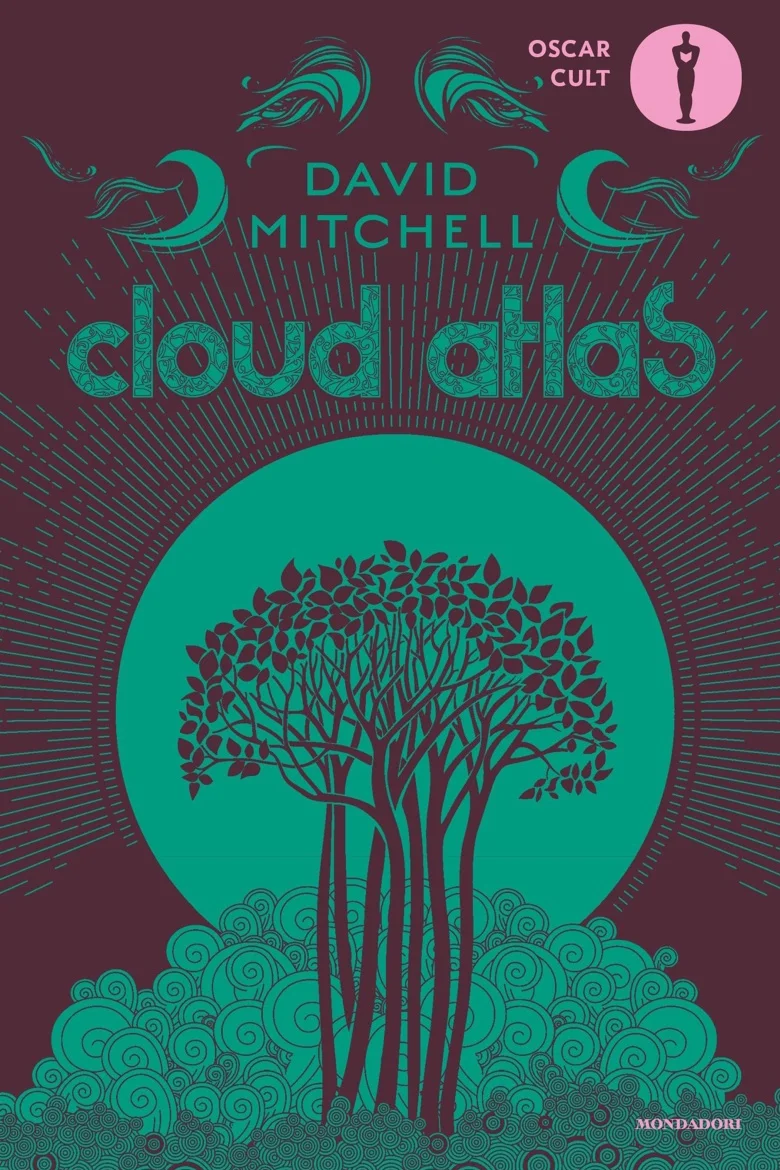
Cloud Atlas
Six stories, each one cut off mid-sentence and found by the next, then finished in reverse
Chapter IAbout the book
- First published
- 2004
- Main genre
- Literary fiction
- Length
- 509 pages
Six narrators in six different periods, and each one reads or witnesses the story before: Cloud Atlas is built like a set of Russian dolls. It opens in the mid-nineteenth century with Adam Ewing, an American lawyer waiting out ship repairs on the Chatham Islands. Ewing keeps a journal of what he sees, including a Moriori slave flogged by a Maori overseer, and at a pivotal moment the journal simply stops. The next story starts in a new time and place with Robert Frobisher, a young composer who has found the first half of that journal and wants the rest. Further on come a journalist chasing a corporate scandal, a publisher on the run, a genetically engineered server in a future Korea, and a goatherd in a ruined world. Each story reaches the next through something placed within the text, such as a letter, a manuscript or a film. The book has six distinct stories, told in eleven parts. The first five break off at a crisis, the sixth stands whole at the centre, and then the earlier stories resume in reverse order and conclude. The voices change with each tale, from a nineteenth-century diary to an invented future dialect.
Chapter IIThe author and the making
David Mitchell was a child who did not speak until the age of five and developed a stammer at seven, and he spent much of his childhood reading alone. His first novel, Ghostwritten, appeared in 1999, before he turned thirty, and number9dream was shortlisted for the Booker Prize in 2001. Cloud Atlas, his third novel, was published by Sceptre in 2004. By his own account the book began with its structure. He had long wanted to write a Russian doll novel after reading Italo Calvino's If on a winter's night a traveller, which leaves its narratives unfinished; Mitchell's change was a mirror at the centre, so that every story could be completed. He wrote the six novellas in order, then assembled the novel in about an hour with cut and paste. The sources are a mix of music and fiction. The title came from a piece by Toshi Ichiyanagi: “I bought the CD just because of that track's beautiful title.” Ayrs and Frobisher were inspired by the composer Frederick Delius and his amanuensis Eric Fenby, Russell Hoban's Riddley Walker shaped the far-future dialect, and Mitchell has also named Jared Diamond, Aldous Huxley, Yevgeny Zamyatin and E. M. Forster. Every main character carries a comet-shaped birthmark. The US and UK editions differ more than most readers realise: the scholar Martin Paul Eve found an astonishing degree of variance, and one chapter was almost entirely rewritten.
Chapter IIIHow it was received
Cloud Atlas was shortlisted for the Booker Prize in 2004 and also won the British Book Awards Literary Fiction Award in 2005. Reviews on publication were mixed, and esteem has grown since. Metacritic gives it 82 out of 100 on 24 reviews. A. S. Byatt praised Mitchell's craft: “He isn't afraid to jerk tears or ratchet up suspense.” Not everyone agreed. Theo Tait of The Daily Telegraph wrote that it spends half its time wanting to be The Simpsons and the other half the Bible, and also objected to a mighty problem of tone. Robert K. J. Killheffer judged that for all its pleasures it falls short of revolutionary, and Tom Bissell found it frustrating, not as smart as its author. Later honours came anyway. The Guardian placed it ninth on its 2019 list of the 100 best books of the 21st century, and Bill Gates, who said he had never come across anything quite like it in a book, put it on his 2020 summer reading list. The 2012 film, directed by the Wachowskis and Tom Tykwer with Mitchell co-writing, cost over $100 million and divided critics: Roger Ebert called it one of the most ambitious films ever made, Mark Kermode an extremely honourable failure.
Chapter IVWhy it matters
Cloud Atlas matters as a proof that a structural trick can carry feeling. Mitchell wanted the form to work thematically, so that the whole thing was not a gimmick with stories meaninglessly presented, and many readers found that it did. Its reach shows in other writers: Shehan Karunatilaka, the 2022 Booker winner, named it a major influence on his own book. It also stands as a showcase of voice, because each story is written in a different register and Mitchell has said the invented far-future language is how a future language will look. Be ready for the cost of that ambition. The first five stories stop at a crisis, so the first half asks you to carry six open threads, and the dialect of the central story is slow going. Critics who disliked the book pointed to its tone and to a sense that the cleverness outruns the ideas. It is a good fit for readers who enjoy puzzles of form and mixed genres, and a poor fit for anyone who wants one consistent voice. A 20th-anniversary edition appeared in 2024. Readers should note that the US and UK texts differ, so quotations may not match across editions.
Chapter VIf you liked this
- If on a winter's night a traveller Italo CalvinoThe unfinished-narratives novel that Mitchell has said inspired the nested structure
- Riddley Walker Russell HobanA far-future novel in an invented dialect, which Mitchell credits for his own future language
- The Bone Clocks David MitchellAnother Mitchell novel that links several periods and voices through connected lives
- Never Let Me Go Kazuo IshiguroA literary novel that borrows from science fiction, shortlisted for the same prize a year later
- Literary fiction
- Science fiction
- Historical fiction
Buying links are coming soon.