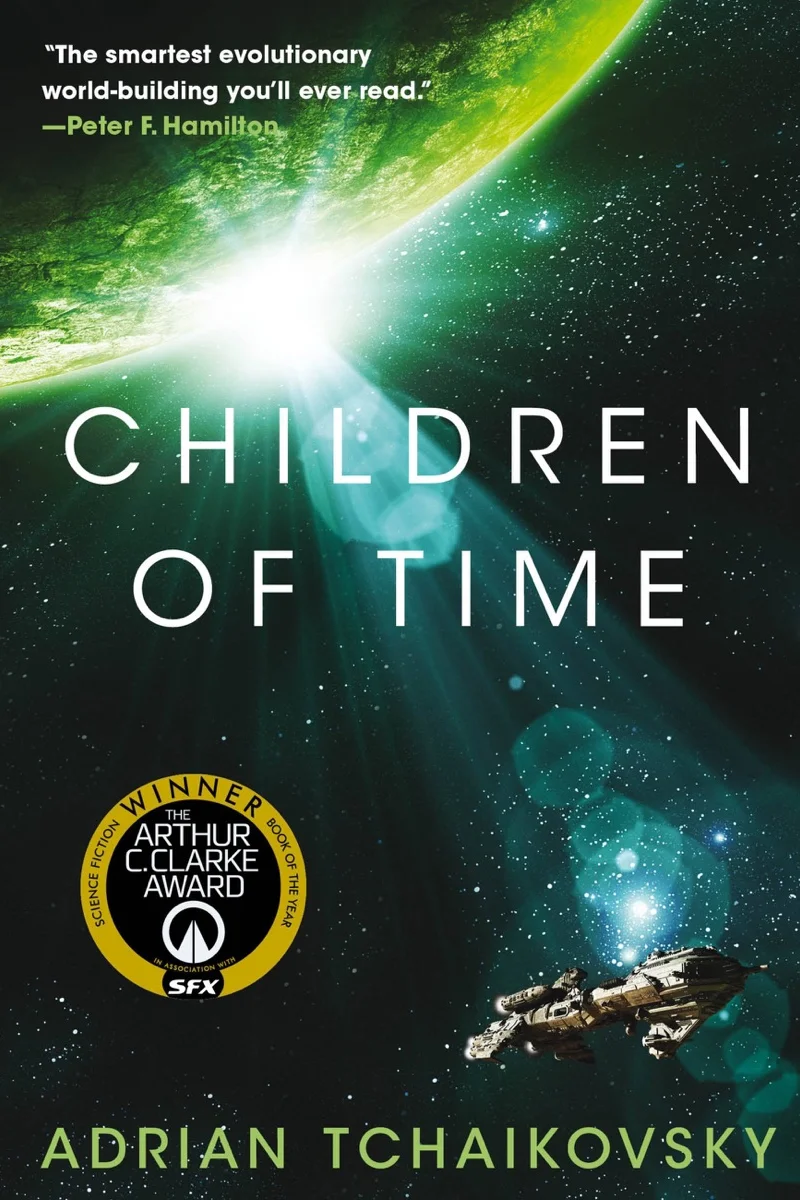
Children of Time
Humanity's last survivors reach a world prepared for them long ago, and find it already belongs to spiders
Chapter IAbout the book
- First published
- 2015
- Main genre
- Science fiction
- Length
- 600 pages
Avrana Kern, a scientist leading a team around a newly terraformed planet, plans to release a nanovirus to speed the evolution of monkeys. The monkeys are lost, the nanovirus alters local life instead, especially jumping spiders called Portiids, and Kern is left stranded in orbit. Millennia later Earth's last humans, dying as their biosphere collapses, travel toward Kern's World aboard the starship Gilgamesh, unaware of the uplifted spiders. Holsten Mason, the ship's chief classicist, who translates the old language Imperial C, is a central viewpoint. The novel alternates between the spiders' perspective and the remnants of humanity, and its spiders are based on the real jumping spider Portia labiata. The spiders' societies advance rapidly while the human crew descends into strife. The book spans roughly 2,000 years of future history, and Tor UK published it in a 600-page edition. The Audible summary describes the setting as “humanity's struggle for survival on a distant world”.
Chapter IIThe author and the making
Adrian Tchaikovsky is a British author, born in 1972 in Lincolnshire, England, who studied zoology and psychology at the University of Reading and then worked as a legal executive. He began publishing in 2008 with Empire in Black and Gold, the first book in the Shadows of the Apt fantasy series, and became a full-time writer in 2018. Children of Time was his first venture into science fiction, and it was the book that took him beyond the fantasy readers who knew the earlier series. Tor UK published it on June 4, 2015. Its spiders are modelled on a real species, the jumping spider Portia labiata, and the zoology degree shows in how the book treats them. The Audible summary lists its themes as evolution and adaptation, clashing civilisations, survival in a hostile environment, artificial intelligence and its effect on organic life, the legacy of past actions, the ethics of genetic engineering and communication between different species. Sequels followed: Children of Ruin on May 14, 2019, Children of Memory on November 24, 2022 and Children of Strife on March 13, 2026. Film rights were optioned in July 2017.
Chapter IIIHow it was received
Children of Time won the Arthur C. Clarke Award in 2016, announced on 25 August 2016 as the award reached its 30th anniversary, and it received positive reviews, including one by James Lovegrove in the Financial Times on 3 July 2015. The chair of the judges, Andrew Butler, said the book “plays with them masterfully on an epic and yet human scale”, referring to the reader's sympathies and phobias, and the award director praised its “universal scale and sense of wonder reminiscent of Clarke himself”. Tchaikovsky received £2,016, the prize being a sum equal to the year. Among the other shortlisted titles was The Long Way to a Small, Angry Planet by Becky Chambers. The reviewer Steve Rice found it “full of engaging characters and situations that utterly convince the reader”, but also wrote: “The story starts slow, dragging in the middle but finally accelerates to a dramatic conclusion.” In 2023 the series won the Hugo Award for Best Series, a win Tchaikovsky has since disavowed because of the ballot controversy that followed.
Chapter IVWhy it matters
Children of Time matters as a first-contact novel in which the aliens are not visitors but a civilisation the reader watches grow up, and as a book that asks readers to sympathise with a species many fear. Butler's judgement that it plays with the reader's sympathies and phobias on an epic and yet human scale is the best short account of its appeal. Its success also helped bring Tchaikovsky, previously known for fantasy, to a wide science fiction audience, and the series that followed has run to four books. The honest reservation is pacing: Rice found the opening slow and the middle dragging before the book accelerates, and at 600 pages it asks for patience. The human characters aboard the Gilgamesh are also the less sympathetic half of the story by design, and readers who dislike spiders may find the first chapters hard going. It suits readers who enjoy big-idea science fiction, evolution and alien societies, and it is a poor fit for anyone who wants a fast, character-driven space adventure.
Chapter VIf you liked this
- A Deepness in the Sky Vernor VingeAnother large science fiction novel with a spider civilisation
- The Long Way to a Small, Angry Planet Becky ChambersA warmer, character-led novel on the same 2016 Clarke shortlist
- Rendezvous with Rama Arthur C. ClarkeA classic of wonder-driven science fiction, by the award's namesake
- Project Hail Mary Andy WeirA friendship with an alien across a language barrier
- Science fiction
- Adventure
Buying links are coming soon.