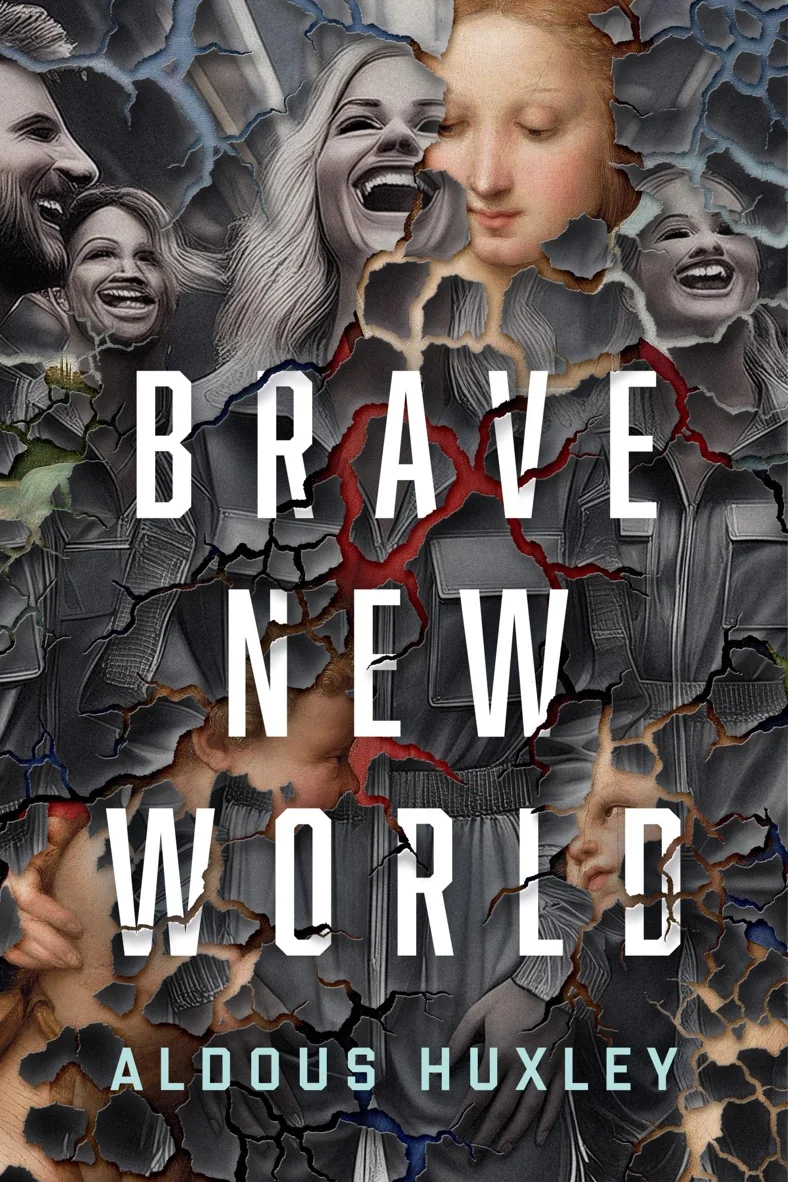
Brave New World
A World State built on engineered contentment, and the outsiders who start to see what it costs
Chapter IAbout the book
- First published
- 1932
- Main genre
- Dystopian fiction
Brave New World is set in a World State in the year AF 632, where citizens are engineered in bottles and sorted into castes from Alpha to Epsilon. Sleep-conditioning teaches each caste to be content with its place, and the population relies on soma, a drug that suppresses unhappiness. The state's motto is “Community, Identity, Stability”, and its citizens worship Henry Ford in place of Christian figures. Bernard Marx, a short, discontented Alpha-Plus psychologist, criticises the system, while Lenina Crowne, a hatchery worker, is popular and conventional. Bernard takes Lenina to a Savage Reservation in New Mexico, where they see natural births, ageing, disease and religion for the first time. There they meet Linda, a former World State woman, and her son John, who has been raised outside the system. Castes are sorted by intelligence and labour, and Bokanovsky's Process lets one fertilised egg produce many identical people, while hypnopaedia, or sleep-teaching, shapes their minds.
Chapter IIThe author and the making
Aldous Huxley wrote Brave New World in Sanary-sur-Mer, in the south of France, over four months from May to August 1931. Shortly before, he had visited the Billingham Manufacturing Plant, a technologically advanced factory in north-east England that made a strong impression on him, and he said the book began as a parody of H. G. Wells's utopian novels, especially Men Like Gods. The title comes from Miranda's speech in Shakespeare's The Tempest, a phrase Shakespeare uses ironically because Miranda is too innocent to see the evil in the visitors. It was Huxley's fifth novel and his first dystopian work, and Chatto & Windus published it in February 1932. In a 1946 foreword he expressed regret about the book's tone, and in a 1962 interview he said its message was: “This is possible: for heaven's sake be careful about it.” He returned to the subject in the essay Brave New World Revisited in 1958, concluding that the world was moving toward his dystopia much faster than he had expected. Bertrand Russell said the novel expanded two chapters of his 1931 book The Scientific Outlook, and George Orwell suggested it partly derived from Zamyatin's We, which Huxley denied knowing.
Chapter IIIHow it was received
The book sold about 13,000 copies in England in its first year, outselling Point Counter Point by 3,000, but early reviews were largely negative: critics called it dry, simplistic and preachy, and M. C. Dawson described it as “a lugubrious and heavy-handed piece of propaganda”. Others were kinder. Rebecca West called it “the most accomplished novel Huxley has yet written”, and Joseph Needham called it “Mr Huxley's remarkable book”. Interpretations differed: G. K. Chesterton read it in 1935 as a revolt against the Age of Utopias, and Ludwig von Mises in 1944 read it as a satire of socialist utopias. It was banned in Ireland in 1932 for its language and supposed anti-family, anti-religious content, banned in India in 1967, and removed from classrooms in Miller, Missouri in 1980; it ranked third on the American Library Association's most challenged list for 2010. The Modern Library placed it fifth on its list of the 100 best English-language novels of the 20th century, and it ranked 87th in the BBC's Big Read in 2003. Neil Postman argued in 1985 that Huxley's forecast may have been more accurate than Orwell's: “Huxley feared that what we love will ruin us.” A television series premiered on Peacock on 15 July 2020 and was cancelled in October 2020.
Chapter IVWhy it matters
Brave New World matters because it imagined control through pleasure rather than force, a different kind of dystopia from Orwell's. Postman's contrast, that Orwell feared an externally imposed oppression while Huxley feared truth would be drowned in a sea of irrelevance, is the usual way readers now frame the two books, and a 1994 Baltimore Sun essay argued that Huxley's prophecy seemed closer to realization. Its ideas, soma, conditioning and engineered castes, have become shorthand for the costs of progress. The honest reservation is that it is closer to an argument than a story. Early critics found it preachy and heavy-handed, its characters are largely types who carry the argument, and Huxley himself later regretted its tone. It suits readers who enjoy ideas-driven fiction and satire, and it is a poor fit for those who want rounded characters or a plot-driven thriller. Read alongside Nineteen Eighty-Four, it shows two very different fears about the same future.
Chapter VIf you liked this
- Nineteen Eighty-Four George OrwellThe usual companion piece: a dystopia of fear and force rather than pleasure
- We Yevgeny ZamyatinThe Russian dystopia that Orwell thought Huxley drew on
- Fahrenheit 451 Ray BradburyA dystopia in which entertainment helps people give up thinking
- Never Let Me Go Kazuo IshiguroA quiet dystopia about engineered lives and acceptance
- Dystopian fiction
- Science fiction
- Satire
Buying links are coming soon.