
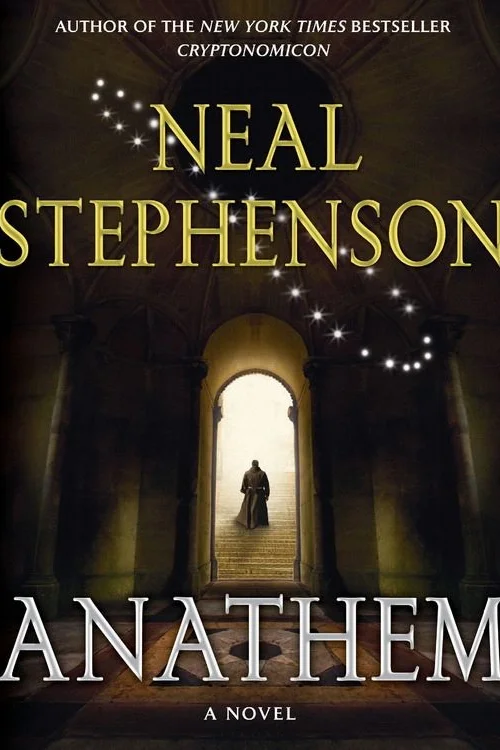
Anathem
Scholars locked behind walls for centuries are called back into a world that has forgotten how to think
Chapter IAbout the book
- First published
- 2008
- Main genre
- Science fiction
- Length
- 937 pages
On the planet Arbre, mathematicians and philosophers live behind the walls of monastery-like concents, and the outside world can reach them only when the gates open. Anathem follows Fraa Erasmas, a young scholar whose quiet routine is about to end. Arbre is a fictional world about 4,000 years on from our own, and its scholars, the avout, have been set apart from ordinary life for a very long time. Erasmas belongs to the Concent of Saunt Edhar. The avout are banned from possessing or operating most advanced technology, and the gates between concent and world open only at intervals of 1, 10, 100, or 1,000 years, in a ceremony called Apert. Erasmas looks forward to the next Apert, when he will meet friends and family from outside. But the calm of his order is disturbed as the world beyond the walls begins to press in, and the avout are asked to answer questions that nobody else can. Stephenson tells it in the first person, in Erasmas's own voice, and fills the book with invented vocabulary: each chapter begins with a definition of one of these words, and a glossary waits at the back. Much of the story is carried by long dialogues in which characters test ideas about logic, physics and what is real against each other. The result reads both as an adventure and as an inquiry into what thinking is for.
Chapter IIThe author and the making
Neal Stephenson came to Anathem by way of a clock. He was born on October 31, 1959, at Fort Meade, Maryland, into a family of engineers and scientists; his father was an electrical engineering professor and his grandfather taught physics. At Boston University he started in physics and switched to geography, graduating in 1981, and he has lived mostly in the Pacific Northwest since 1984. Snow Crash made his name in 1992, Cryptonomicon followed in 1999, and the Baroque Cycle, with Newton and Leibniz at its centre, appeared in 2003 and 2004. He also worked for several years at Blue Origin, Jeff Bezos's spaceflight company. The clock was the Clock of the Long Now, thought up by the inventor Danny Hillis and developed by the Long Now Foundation, and designed to run for 10,000 years. Stephenson first heard about it from Hillis and Stewart Brand at the annual Hackers Conference, later travelled to the clock's sites with them, and contributed early ideas of his own. In his back-of-the-napkin sketch in 1999 he drew a clock enclosed by concentric walls, with gates that governed who could enter or leave. A version of that sketch went up on the Long Now website in 2000. Then, in his words, he put the idea in cold storage, because he was writing the Baroque Cycle. When he came back to it, the idea took the shape of a monastery. He had been struck by how little of the daily news he would remember, and imagined a community that reconnects with the outside world only at set intervals. He chose a first-person narrator because it made the invented world easier to explain, and set the book on another planet so that his characters would not have to keep footnoting our history. He modeled the avout on medieval European monastic communities. His working method was plain: read yesterday's pages, edit them, then write new ones. For Anathem he printed the manuscript and reread it more often than he had for the Baroque Cycle. William Morrow published the novel in the United States on September 9, 2008, and the Orth language used by the characters was created by Jeremy Bornstein at the author's request.
Chapter IIIHow it was received
The launch was a show. The Long Now Foundation staged it at the Regency Ballroom in San Francisco on September 9, 2008, with over 900 in attendance, chanting composed for the book by David Stutz, a reading of the opening pages by Stephenson, and a demonstration of “shovel-fu,” a martial art invented in the novel. Anathem debuted at number one on The New York Times hardcover fiction list, and the journal Nature reviewed it. Wired ran a feature by Steven Levy on the Long Now background in the September 2008 issue of Wired. It won the Locus Award for Best Science Fiction Novel in 2009 and collected nominations for the Hugo, Arthur C. Clarke and John W. Campbell Memorial Awards. Critics divided sharply. Andrew Leonard called it “an adventure novel and an extended existential meditation,” while Michael Dirda dismissed it as “grandiose, overwrought and pretty damn dull,” and David Itzkoff wrote that it “forgets to come up with much that is new or true.” Paul Boutin, on the other hand, praised Stephenson's wry contempt for a just-Google-it mindset. Stephenson himself was cautious about its fate: “Time will tell whether I'm going to get away with it or not.” He also joked about the irony of writing a huge book about how people no longer read huge books. The Long Now Foundation, whose clock project inspired the novel, judged it by a different measure. Its stated goal for the clock has always been to inspire new myths, and it calls Stephenson's one of the first.
Chapter IVWhy it matters
Anathem matters first as an attempt to write a novel about the life of the mind that does not apologize for being intellectual. Stephenson drew heavily on Platonism, and his characters spend long stretches testing ideas about logic, physics and what is real against each other. The setting also turned a design problem into fiction. The Long Now Foundation says the book uses many of the real mechanisms devised for the 10,000-year Clock, and sets them in a society where such clocks are part of the civilizational fabric. Stephenson was described as seeking a place among the old guard of speculative fiction, alongside Asimov, Clarke, Heinlein and Huxley, and the book takes up their habit of using science fiction as a vehicle for argument. Boutin found its lasting satisfaction in the author's wry contempt for a just-Google-it mindset, though whether its ideas are original is disputed. Expect to work. At 937 pages in the hardback, Anathem asks for patience. The first chapters bring in a great deal of invented vocabulary before the plot gathers speed, and Stephenson added a glossary for readers who need it: “Use it or not depending on what sort of reader you are.” The long dialogues will tire anyone who dislikes talk and abstraction, and Dirda's verdict that it is pretty damn dull comes from a reader who did not enjoy that. The book stands alone, so no earlier Stephenson novel is needed. It suits readers who enjoy argument as adventure, and it is a poor fit for anyone who wants brisk, plot-driven pages from the first chapter.
Chapter VIf you liked this
- A Canticle for Leibowitz Walter M. Miller Jr.Monks guard scraps of learning through a long dark age, another monastery story about knowledge and time
- The Glass Bead Game Hermann HesseA secluded order of scholars devoted to a game of ideas, set apart from the wider world
- The Name of the Rose Umberto EcoA medieval abbey full of books and arguments, with a mystery that turns on what may be read
- Cryptonomicon Neal StephensonStephenson's earlier long novel, with the same love of mathematics and talky set pieces
- Science fiction
- Philosophical fiction
- Adventure
Buying links are coming soon.