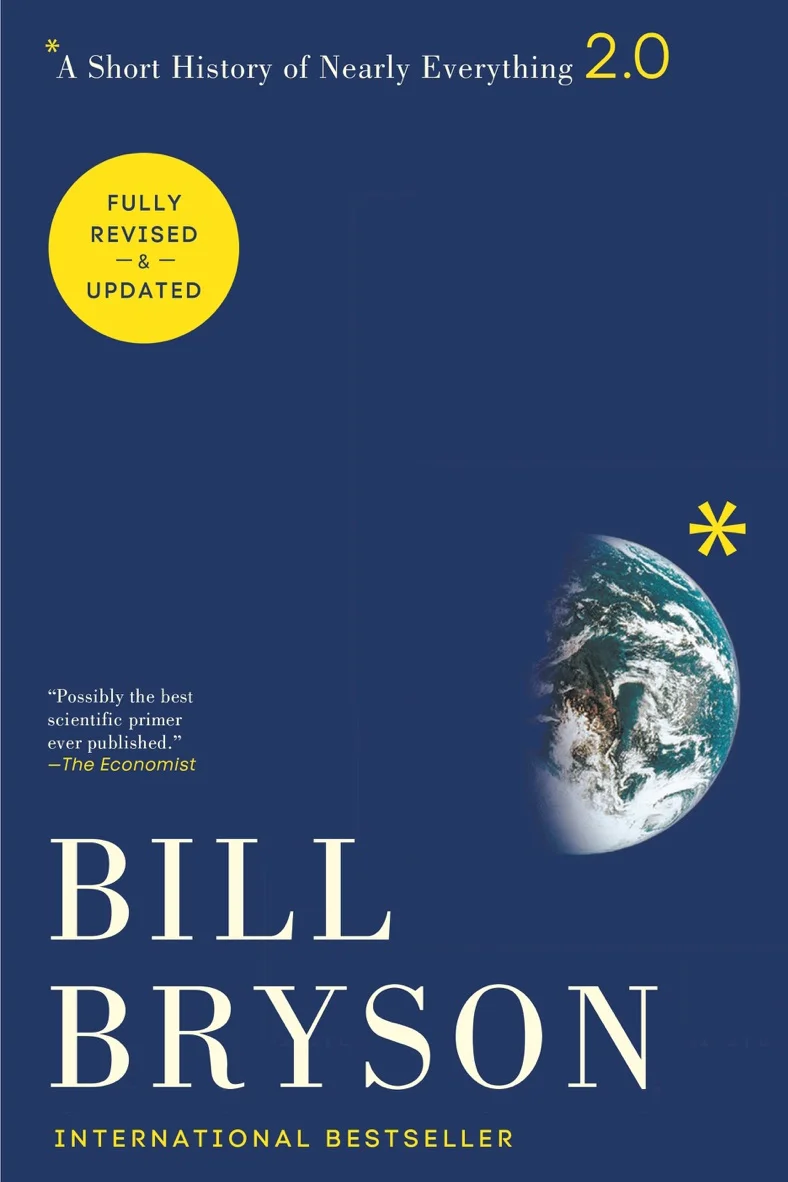
A Short History of Nearly Everything
A travel writer decides to find out how we know what we know about the universe, the Earth and life
Chapter IAbout the book
- First published
- 2003
- Main genre
- Humanist philosophy
- Length
- 515 pages
A Short History of Nearly Everything is a popular science book that explains general science in accessible language. It moves from the Big Bang to the discovery of quantum mechanics, covering chemistry, paleontology, astronomy, particle physics, evolution and geology. Along the way it describes the scale of the universe, atoms and subatomic particles, traces life to modern Homo sapiens, and discusses meteorite impacts and volcanic disasters such as Krakatoa and Yellowstone. Many anecdotes about the eccentricities of scientists appear throughout, including profiles of an amateur supernova hunter, a Yellowstone geologist and a moss specialist. The chapters are self-contained, so readers can take them one at a time, and Bryson makes the scale of the material concrete with analogies, such as one that imagines flying backwards through time at one year per second. The book closes by reminding readers how much remains unknown, and its theme is humanity's rare and fragile position in the universe.
Chapter IIThe author and the making
Bill Bryson was already known for travel writing when he wrote the book. He was dissatisfied with his own scientific knowledge: school science had felt distant and unexplained to him, and his textbooks never addressed the whys, hows and whens. He could not find a book that answered his questions, so he decided to write one, and he spent about three years researching it, meeting scientists and reading widely. His style departs from traditional popular-science conventions and is deliberately simple. Doubleday published the book in the UK and Broadway in the US, on May 6, 2003, and the UK hardback ran to 515 pages. The reviewer Graham Farmelo credits Bryson with citing his sources carefully, though Shawna Williams of CERN noted that he relies on popular sources such as The Economist at least as often as on scientific papers or his own reporting. An illustrated special edition was released in November 2005, and the audiobooks include an abridged version read by Bryson himself. A second edition, published in late 2025, recognised errors in the original and includes extensive revisions to every chapter.
Chapter IIIHow it was received
Reviews in 2003 were generally favourable. Kirkus called Bryson “a man who knows how to track down an explanation and make it confess” and praised the human stories and humour, though it said the most counterintuitive ideas, such as time being part of space, may defeat some readers. Shawna Williams in CERN Courier called it “an entertaining and informative 500-page book about science”, while also saying that “there are a number of errors, some of them cringeworthy”. Graham Farmelo in the Times Higher Education Supplement praised its breadth and its readability, but found many simple mistakes that should have been caught, unclear passages on the expansion of the universe and on mass and weight, and tiresome constant crediting of sources. He noted that the book does not discuss chaos theory and argued that the publisher should have employed academic fact-checkers before rushing it to market. The book won the Aventis Prize for Science Books in 2004, and Bryson donated the £10,000 prize to the Great Ormond Street Hospital children's charity; it was shortlisted for the Samuel Johnson Prize in 2004 and won the EU Descartes Prize for science communication in 2005. It sold over 300,000 copies in the UK and was one of the bestselling popular science books there in 2005.
Chapter IVWhy it matters
A Short History of Nearly Everything matters as the book that showed a non-scientist could make popular science a bestseller by following his own curiosity and being honest about what he did not know. Its reputation rests on readability and humour: reviewers praised its analogies and its attention to the messy, human side of science, including dead ends and rivalries. It also gave many readers a first accessible tour across physics, chemistry, geology and biology in one volume. The honest reservation is accuracy. Two of its first reviewers found errors, one calling some of them cringeworthy, and the author's own publisher later recognised errors in a heavily revised second edition, so it is better read as an enthusiastic introduction than as a reference. Some readers will also tire of its constant crediting of sources. It suits readers who want an engaging, funny overview of science, and it is a poor fit for those who want a rigorous treatment of any single field or who need up-to-date figures.
Chapter VIf you liked this
- Cosmos Carl SaganA classic, lyrical popular-science tour of the universe
- A Brief History of Time Stephen HawkingA shorter, harder popular account of cosmology
- The Selfish Gene Richard DawkinsPopular science on evolution, more argumentative than Bryson
- At Home Bill BrysonBryson's later, equally curious history of everyday domestic life
- Humanist philosophy
- Comedy
Buying links are coming soon.